


In early June I added a daily walk to my morning routine. I’d spent the winter hunched over writing projects, HappyLight ablaze to stave off seasonal gloom. I’d tried to stick to my daily exercise routine, but by the end of each dark, cold afternoon I’d often chosen the comforts of my kitchen over those of the gym. What’s the use, I’d grumble to myself. My stupid post-menopausal body isn’t responding, anyway.
I reckon I’d reduced my activity by about twenty percent. Not terrible, but in the long run the choice was self-defeating. Exercise lifts my mood, as does getting out of my teeny-tiny context to mingle with others, even strangers in a gym. My body started to go soft in new and startling places, which hardly helped my self-esteem. I’ve long suffered from one form or another of body dysmorphia, even though I’m probably what others would consider slender. Turns out I’m capable of feeling bad about my body no matter what it looks like.
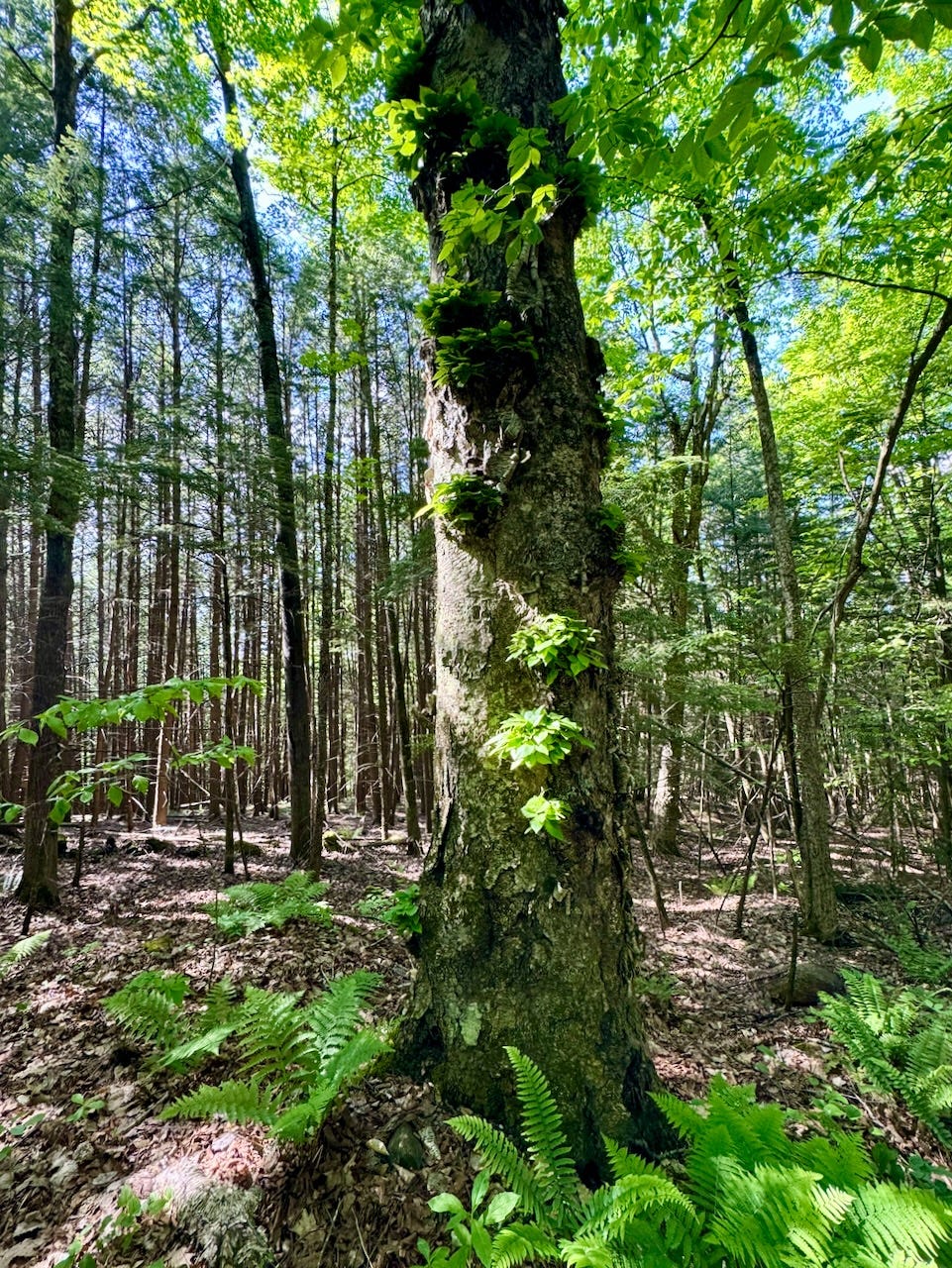
But here it was spring, that time of beginnings. I figured if I could resume the hour of regular daily training, plus add an hour of walking, the unwanted soft spots would swiftly harden.
“I need take my carcass for a walk,” I declared that first day, slapping my hindquarters as I headed out the door. It was a brilliant morning, shiny, new leaves riffling and birds shouting good news about the territory. I wasn’t far from home before I realized I should soften my tone. I need to re-cast this, I thought, more from a sense of charitable self-obligation than professed self-love.
Let’s see. So, like, if I had a dog I’d happily commit to a daily walk. Maybe my body is the dog?
Ugh, terrible analogy.
Maybe I’m just taking myself for a walk. Just my body. Or, my well-being. That sounded more like something worth doing.
My household sits at one end of a two-mile stretch of rural dirt road. It’s extensively wooded except for a few big fields and about a dozen houses. It’s lonely, mostly. During covid I’d often venture out and not encounter another soul. At the time that was fine by me, for reasons both epidemiological and psychological. Those daily walks were a salvation. Maybe I could rediscover some of that feeling too.
The neighborhood backs up to hundreds of acres of hilly wilderness. I’ve seen bears on my walk, once or twice a bobcat, often deer, lately a mother and a fawn, its spots fading. Birds, of course, which I’ve learned to recognize by song, since they’re away so high in the treetops. Warblers of all colors: black-throated blue, black-throated green, yellow, chestnut, pine. Thrushes, flute-like, and the many busy woodpeckers. Vireos, tanagers, orioles, buntings and other colorful characters. Ravens and crows, hawks and falcons. A new family of five turkey vultures. Once or twice an eagle.
This summer I’ve been heading out after breakfast. Evidently my neighbors are morning people, so we cross paths, variously walking, running, or cycling. There’s always a handful of cars and pickups, all local traffic. No one uses this road as a thoroughfare.
I’ve gotten used to everyone’s rhythms. Neighbor Tom walks his golden-doodle Rosie, but sometimes his wife Sally has the dog, who, she says, gets more salon treatments than she does. John, tall and voluble, eighty-two but looks sixty, walks five miles a day, sometimes yammering into a cell phone. I asked him how he got coverage up here in the shadow of every worldly signal. “Mint Mobile!” he boomed. “Thirteen bucks a month. Unlimited minutes!” Neighbor Heidi walks with a rotating cast of friends and dogs, and it’s unclear who belongs to whom, but they’re good about holding them as I pass. I was attacked by a different dog four years ago, on another road nearby. They don’t know that, but I welcome their courtesy. Sometimes I greet my neighbor’s harlequin cat, who runs at me, tail-up, and flops herself onto my shoes for scrumbles. My own cat will notice this later.
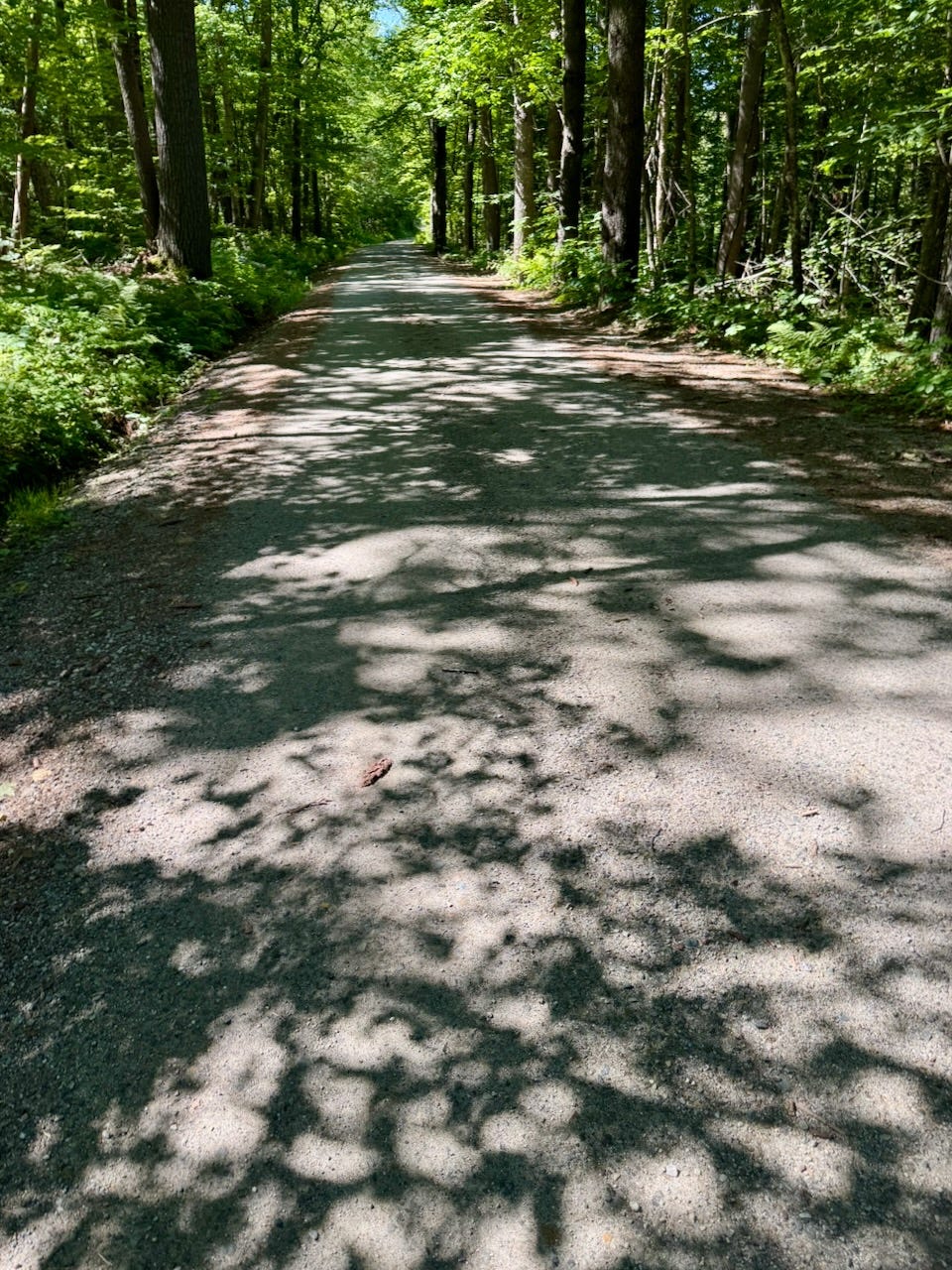
I recently met Mike and Christy. We’d been passing each other all summer, but they’re joggers and I hadn’t wanted to interrupt. Meetings and greetings here follow a strange northern politesse. Speed is a factor. People in cars get a wave, a gesture of shared humanity when you’re the only two for miles. Ditto cyclists, and anyone with earbuds. Fellow walkers offer the best opportunity for interaction, but you don’t ask names on first encounter. You just smile and keep about your business, with limited eye contact. The next time you both say Hi and maybe mention the weather. After three to five encounters like this, you mention something you’re confident they’ve also experienced: the July 4th celebration or the overnight power outage or that big tree that finally fell by the turn. You might stop to chat for a minute. Then the next time you see them you say, “By the way, I’m Meg. What’s your name?” New England means the reticence of strangers, even friends.
So it’s been a full summer of daily walks. I’ve missed only two days thanks to foul weather, and I did also manage to add back my daily hour of training, weights and otherwise. My exercise minutes are off the charts, but I haven’t lost any weight. If anything I’m hungrier, and stronger. Maybe this is just my shape, now, larger in the world.
This week the songbirds have gone silent. They’re molting, changing out of breeding plumage into a sturdier suit of feathers to propel their fall migration. Molting makes them clumsy and vulnerable, so they hunker in the underbrush, keeping a low profile so as not to advertise their whereabouts. In a few weeks they’ll begin departing in waves, parents and young alike, to fly the improbable distances back to their wintering grounds, powered by the bugs and seeds and fruits of my territory, or rather our territory.
School starts next week. If I’m out in the afternoon I’ll pass my neighbor’s kids en route home. They take the bus in the morning because it’s a two-minute ride. But the route reverses at the end of the day so theirs is the last stop, 45 minutes. They can walk the two miles home in half the time, stooped under monumental backpacks I cannot believe actually hold books.
So here it is fall, that time of re-beginnings. The French call it La Rentrée, the return or re-entry. I like that construction, because it does feel like a re-set, a resumption of old routines. It also acknowledges that summery sense of suspended animation, the way time holds its breath in August, waiting to exhale. It’s a moment that invites us forward, but also invites us to consider what we’re leaving behind.
Here’s what I’m reading this week
Seeing the Extra in Ordinary
In Ordinary Abundance, animator Jordan Dworkin asks us to consider how many of our everyday household objects, things we take for granted, would have felt miraculous even a generation ago. Electric lights, reading glasses, temperature control, plumbing. “All the items in this room were once out of reach; some not yet invented, others too rare or costly for the vast majority of people. Today, most of us lucky enough to live with them walk past without a second thought.” His animation suggests we should try to recapture “the old sense of awe at these wonders that have long since become commonplace.”
European Wine, Mapped
Belgian tech consultant Boris de Vloed recently launched a free interactive tool to explore European wine regions. To create Open Wine Map, de Vloed sourced published data from the INAO, French cahiers des charges, Italian disciplinare, and other appellation datasets, then used Claude to couple them with mapping data. (Read more on the process in this post by Reinier Broeks.) The map allows searching, sorting, and filtering by region, grape, and wine style. The precision is boggling and the visualization affords direct comparisons between and within regions. A cursory cruise across, say, northern Piemonte shows how tiny Barolo and Barbaresco are compared to the broader wine territory. Scroll over to the Côte de Nuits and the minuscule scale hits even harder. It’s a new, invaluable resource for students, scholars, writers, and sundry wine connoisseurs.
The Cellar as Biome
Winemaker-philosopher Clark Smith does not shy from certain cellar techniques to speed a wine on its way, but he’s also learned to work with, rather than against, busy, busy nature. The cellar is a microbial biome, he writes, and the wine needs a diversity of microorganisms to mature properly. Sterile filtration might prevent problems later, but it also prevents evolution, and can also allow a single stray microbe, Brett, for example, to run utterly wild. “Since sterile filtration is a 20th Century invention, French winemakers have been for hundreds of years making great wines that are unsterilized, so why should they start now?” He cautions winemakers to have “a bit more faith in their microbiome.”
West of Eden
Whenever I’ve visited Mt. Etna, the producers and their Consorzio have made clear that the only wine on Etna is grown in the reverse-C that rings the eastern slopes of the volcano. The west is nothing but nut trees and fruit orchards and olive groves, if you take their word for it. True, the Etna D.O.C. appellation is limited to that narrow crescent, but wine is absolutely produced on the western slope, and has been for centuries. In The Other Etna, Roberto Frega shares why Grenache dominates the plantings thanks to a twisty history involving a French Duchy, Spanish enologists, and vines that survived phylloxera. Frega shares the work of a “small, combative community of Etna growers. All of them started making wine no more than ten years ago, and nearly all of them farm on the mountain’s lesser-known slopes.”
Guy on Guywear
I don’t know what it says about me that I’m more drawn to menswear than women’s. It’s something about the silhouettes but also the evident ease, wearability, fabrics, and tailoring that rides along with the category. Menswear writer Derek Guy recently joined Substack and is helping me unpack my preferences, as in this Note about building a coherent wardrobe. “[W]hen buying clothing, pay attention to which qualities you prefer and think about ‘emotional durability.’ Will you enjoy wearing this thing five or even ten years from now? As much as you enjoyed wearing it on the first day?” He offers a four-step process that seems simple enough. I’m definitely due for a re-set.
See you next week.
Images ©2026 Meg Maker
La Rentrée.... to anybody who lives in France it means supermarkets focusing on selling materials for the impending school year; pens, pencils, notebooks, etc. But once that's finished, in September those same shelves are restocked with wine for the "foire aux vins". Always worth looking at because even the worst supermarkets can manage to offer a decent bottle or two.
The interactive wine map sounds like a great idea but may need a little work still. I'm currently in Imperia, Liguria and apparently the local grapes here are Sicily's Cataratto and something so obscure (and French) that I've already forgotten the name. No mention of Vermentino or even Pigato. Still, a nice idea.
Reminds me of when I would take long walk on the dirt roads of Ludlow, VT, before Okemo became a resort rather than just a ski area.