


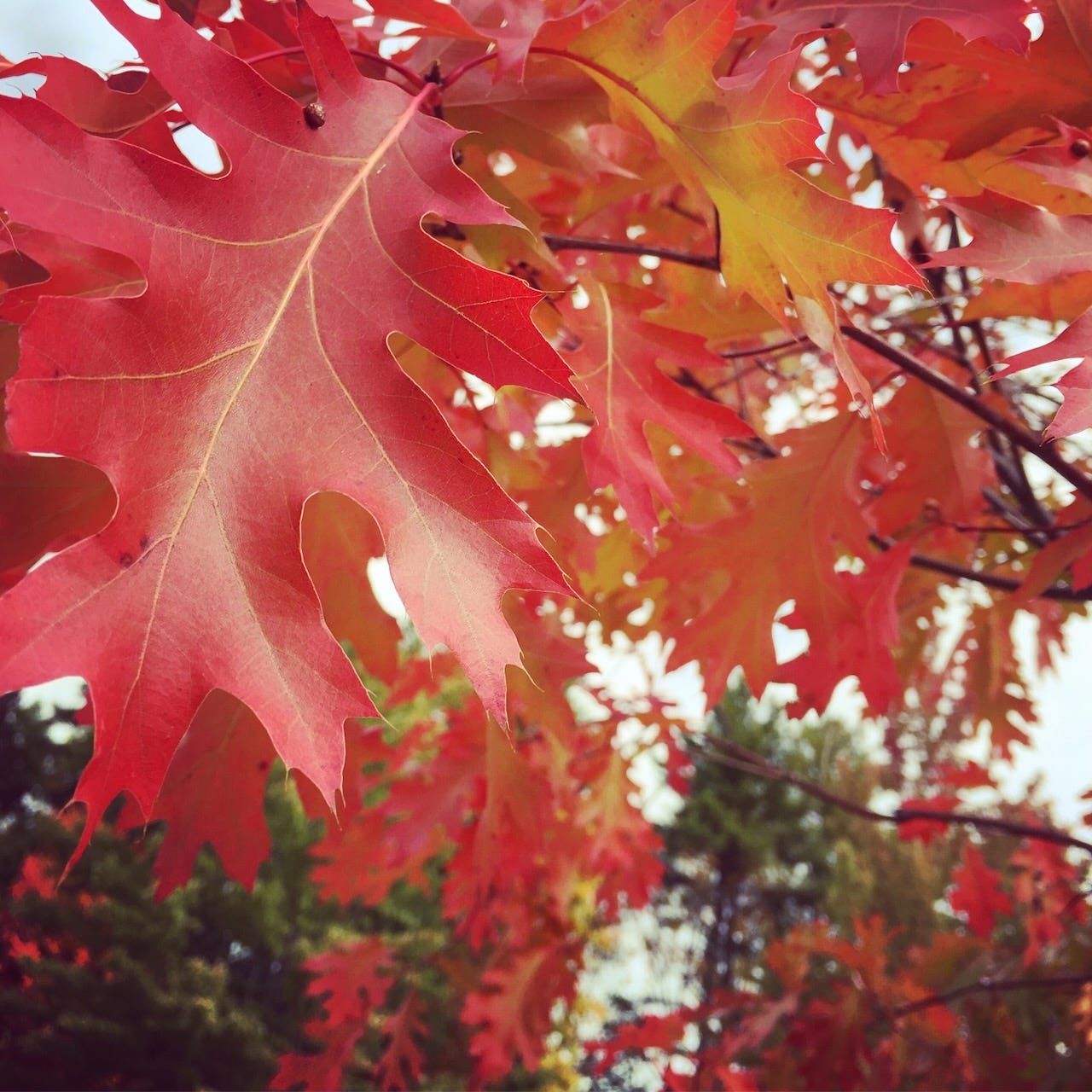
The trees are flying at half-staff here in northern New England. The weather has been handing us a mix of sparkling skies and windy rain, sometimes both within the hour, driving gales of leaves aloft. Spent foliage in orange and yellow carpets the lawn, even as the rain makes it impossible to gather it for mulch. Anyway, I’ve been suffering a chest cold since returning from Italy. The leaves will have to wait.
Fall is a final call for outdoor projects: touching up house paint, dividing perennials, washing windows—all the tasks that seemed so small during the expansive days of summer. There is a deadline looming. Not a hard one, not one whose date can even be seen except in the rearview mirror. It pivots on the powering down of the sun’s engine, which makes the days not only colder but shorter, too, so even before I run my backups and quit my office for the kitchen, night pulls its curtain across the sky.
Soon the ground itself will lock up, turning pickaxe-hard below the trees’ black branches, the earth creaking slowly into solid state. We call November stick season, and no, Noah Kahan did not invent the phrase; he merely used it to evoke the lonely hole in the heart of his story. In winter I too struggle to remind myself that happiness lives in the world, and by late February I hit the lowest threshold of my emotional resilience. Mercifully, the light warms up in early March, and while that’s still two months before the trees get dressed again, it’s enough to rekindle hope.
Here’s what I’m reading this week
Please, not « du vin »
“You’ve found a terrace, the sun is out, and the server is coming,” writes French language coach Timothée Lesoin, of French with Timo, and it’s your turn to order the wine. Lesoin comes to your rescue with his new indispensable guide for ordering, pouring, and discussing wine in la langue de Molière. “[N]o tasting notes. Just the phrases and unspoken rules you need to know to order wine in France the way the locals do, so the server can relax and you don’t end up with de la piquette in your glass.” If you like this one, he’s also penned a flawless companion guide to le bar. Merci, Timo!
No mere cupboard love
Writer and recipe developer Sara Keene just decamped to Paris for the winter, taking the keys to a sterile studio apartment in Montmartre then swiftly provisioning the larder for seasonal cooking. “To fill a pantry for fall is like filling a jar with pennies,” she writes. “Some weeks later, you’re rich in warm hues of red and copper, in ingredients that fill you with every bite. After all, everything in fall is better than the sum of its parts.” Keene lists the staples she always keeps on hand, plus ones especially tuned to her favorite autumnal meals. My own list overlaps; I think we’d like each other’s cooking.
Where will they stash the loot?
Last Saturday, thieves broke into the cellars of iconic Tuscan winery Marchesi Antinori and made off with 30,000 bottles of Solaia, Guado al Tasso, and Tignanello, all from the 2023 vintage. The heist was well organized; robbers disabled the security system before loading the wine onto two trucks—using the producer’s own forklifts. “The gang was very prepared,” said chief executive Renzo Cotarella. “A theft of this scale and value has never happened before in Italy.” The loss totals €5m ($5.6m), and the insurance is insufficient, but the company’s confident the wine will be recovered. Meanwhile, if anyone offers you a bottle of ’23 Tignanello at a price too good to be true, call the Carabinieri.
Decisions, decisions
Writer and Burgundy wine producer William Kelley ruminates on the eternal question: When to harvest. “Burgundians arguing the merits of picking early or late is nothing new,” he writes. Hundreds of years ago, producers picked a mix of under-ripe, ripe, and over-ripe (even rotten) grapes to create wines with energy and tension. Starting in the 19th century, they strove for later harvests to achieve riper, bigger wines that were both more age-worthy and more expressive of place. “I would argue that this is no mere coincidence but rather that the two concepts—maturity and identity—co-evolved,” he writes, noting that admixtures dilute that valuable site expression. On the other hand, those who favor late picking need a high tolerance for risk.
Burgundy on the brain
Wine importer Steven Graf is more blunt: “[M]aking Burgundy is a royal pain in the ass.” He cites Pinot’s thin skin, tight clusters, and susceptibility to disease—and that’s before you even start to make the wine. Lacking a Burgundy in his portfolio, he recently tasted with a new-ish producer and to his surprise found the wines “punchy, tannic… shaded with toasted oak… they felt enormous.” They did not align at all with his understanding of Burgundy, but to be fair, that understanding was formed years earlier and, given the price of the stuff, not kept current. So he set about tasting to try to zero in on the contemporary meaning of “Burgundian style,” and—well, just read what he discovers.
A wine to take us out
Château Fontanès Pic Saint-Loup Rouge 2020
14.2% ABV | About $22; imported by Kermit Lynch Wine Merchant
The last time I was in the Languedoc I fell hard for the wines of Pic Saint-Loup. These blends are spicy, fragrant, and zestier than many Languedoc reds thanks to the cooling night air of that Pic, a steep two-thousand foot mountain that lies at the center of the appellation. This one’s a blend of 40 percent Syrah, 20 percent Grenache, 20 percent Mourvèdre, and 10 each of Cinsault and Carignan; farming is practicing biodynamic. Winemaker Cyriaque Rozier also manages Château La Roque, but Fontanès is his own hustle, 4.5 hectares of vines scratched into the rocky Jurassic limestone. The wine is fragrant of violets and leather, blackberries and their leaves, and its texture is pillowy—plenty of stuffing but not dense—with agreeable fruit and a smooth finish. I served it with braised chili-spiced pork as a dinner to herald fall. The wine and food met eye to eye.
See you next week.
Images ©2026 Meg Maker