


I spent the spring term of my junior year in Florence, Italy, studying Italian Renaissance art. Our small group of American students was domiciled in a pensione one street back from the Arno, close to the museums and churches, piazzas and streetscapes that were our classroom.
I’d arrived with about $200 in my pocket expecting, with irrational optimism, that my scholarship funds would swiftly come through. Unlike my peers I had neither credit card nor foreign bank account, so I resorted to tucking my thin roll of bills in my nightstand.
Fees for housing, transportation, and museums were covered by the institution, but lunch and dinner were on us. I’d been told we’d be able to cook in the kitchen of the American Church, but this option was briskly taken off the table after Reagan bombed Libya and the Florentine streets erupted in anti-American rallies. So I’d have to skimp.
Fortunately, breakfast was provided by the pensione. Italians don’t lean hard on the meal. Signora Gennarini, the petite co-proprietor, bustled about the breakfast room with trays of cappuccino and baskets of white rolls, setting out cold milk, butter, and diminutive jars of jam. It was possible to request a pot of latte caldo, which I could pour over the muesli I stashed in my room. But essentially we all started our day with white starch and dairy and sugar, adequate to slake hunger but nutritionally nothing to bark about.
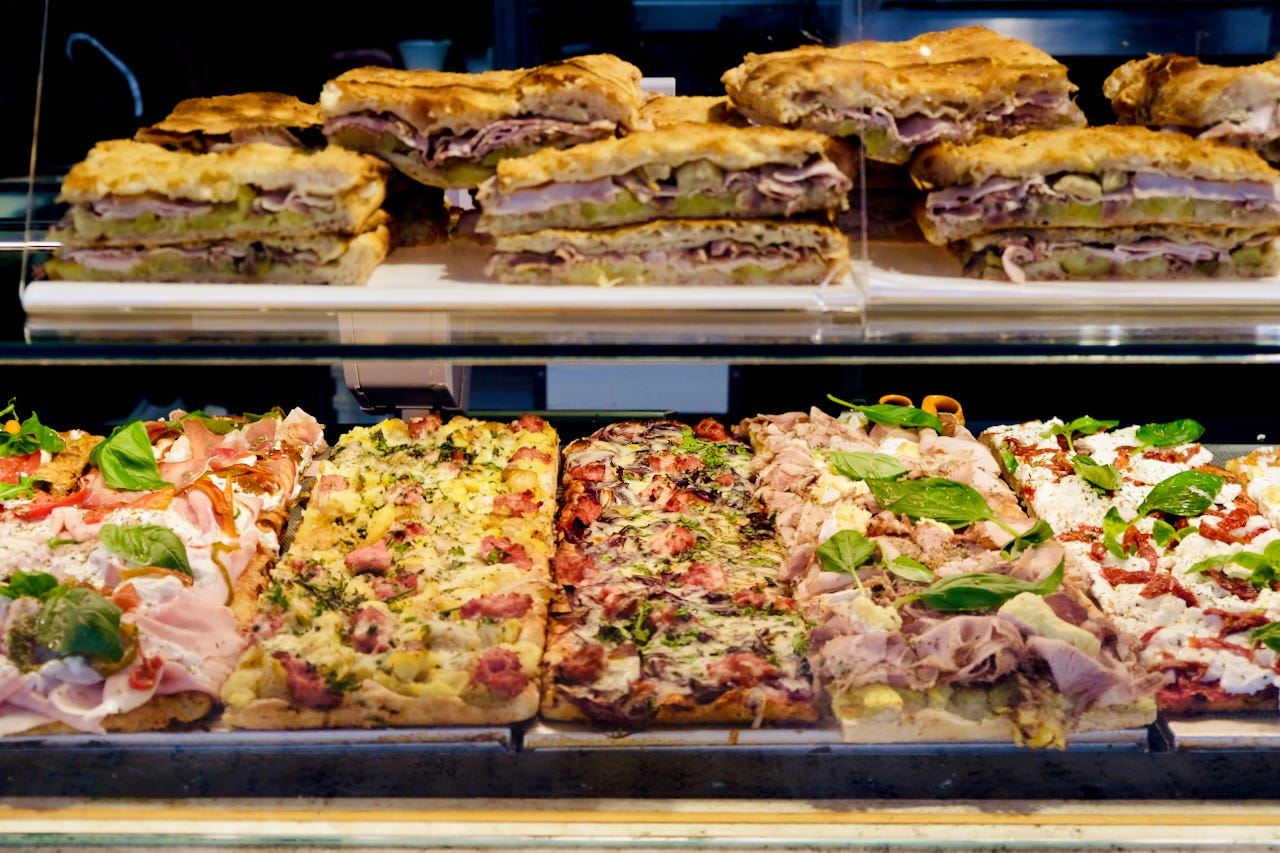
Lunch was often bought on the fly during our peregrinations throughout the city. Even in the mid-1980s, Florence was ablaze with storefronts selling pizza and focaccia by the slice. I remember my first order. My classmates had lined up, but I hung back to listen to the banter. I joined my friend T. in the line, scanning the labels on the different flavors, mouthing their pronunciations sotto voce. I whispered toward T., “How do you say funghi?”
“Fooon-ghee,” he said. “Peeet-zah fooon-ghee.”
Suddenly it was my turn. “Due pizze funghi, per favore,” I heard myself say to the man across the glass. He wrapped two slices in thin parchment and handed them back as I fiddled with the mysterious coins.
The line moved on. “Look at you!” T. said. “I thought you said you didn’t speak Italian.”
“I don’t,” I said. “I’m a good mimic.”
“And willing to try,” he said, gesturing to the students behind us. “They’re all ordering in English.”
I did not want to be that person. I wanted to try to speak the language of Italy, or rather not to speak the language of America, to be that tourist who assumed everyone was there to serve her. Our coursework was conducted in English, but we’d been required to take two terms of Italian before enrollment. I’d done prior classwork in three different Latinate languages but not Italian. I had promised to study on my own, which had apparently satisfied the Art History department chair, but I’d done no more than crack a slender Berlitz phrase book.
Back then it was less common for Italians to speak English, and I swiftly learned there is no quicker way for me to grasp a language than to fumble around and find out. Sometimes I would catch my interlocutor’s every other word and also miss the crucial “non” that turned the sentence inside out. But I quickly realized that as long as everyone stayed in a generous mood, we could make ourselves understood.
Fortunately for my wallet, I soon discovered a cafeteria a block from the pensione. It was a traditional tavola calda, a hot lunch counter that at midday buzzed with shopkeepers, construction workers, museum attendants, and other Florentines who weren’t afforded the luxury of time to return home properly for la pausa pranzo, the traditional midday break. Many of their neighbors still did so, closing their storefronts at noon to venture back to their home neighborhoods where their wives or mothers or grandmothers or all three would have spent the morning cooking the midday meal. Three hours later the proprietors would toddle back and reopen their shops, remaining open for a few more hours before closing for the day at 6:00 or 7:00 p.m. To a naïve American and blossoming second-wave feminist, the practice struck me as thoroughly retrograde. I hadn’t yet learned that human fulfillment is culturally contingent.
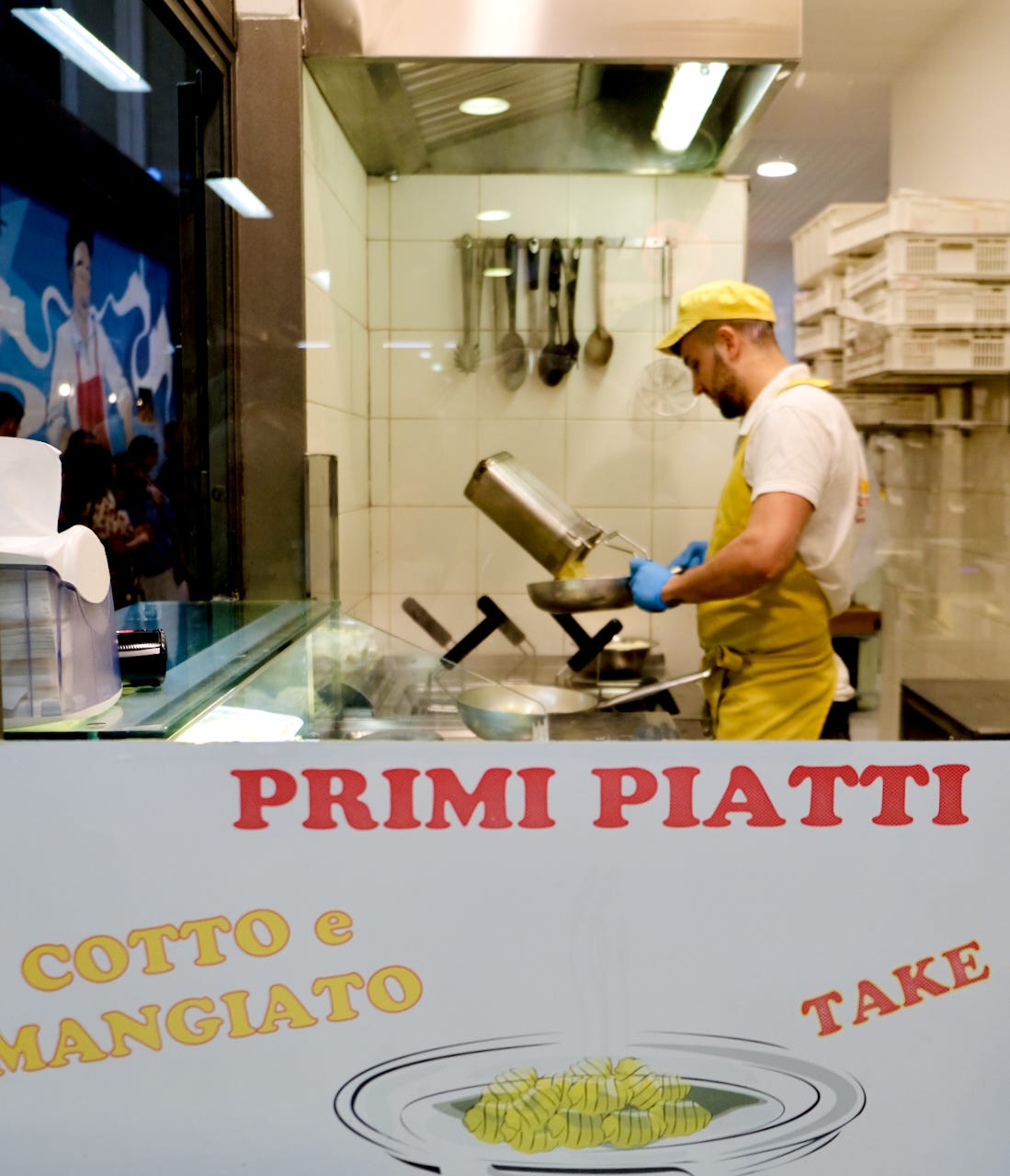
The cafeteria in my neighborhood was ringed by steam and cold counters and striped in the center with long communal tables. Put completely out of your mind the school cafeterias of youthful suffering. The mechanics were the same, even the equipment, but this was Italy, and this was lunch, which meant a vast deliciousness of first and second plates, side dishes hot and cold, and sweet things and fruit. One could order simply or lavishly, and the business-like attendants did not judge, because there was no incentive to upsell, cross-sell, or supersize. It was as civilized and convivial as any restaurant, just way cheaper.
It was also a way to meet others. Once, a woman in her thirties set her tray across from me, smiling with “Buon giorno.” I replied in kind, but something in her accent suggested she was not herself a native speaker.
“Di dove sei?” She asked where I was from.
“Stati Uniti,” I said, “Sono americana.” I hoped the conversation did not escalate, because I would soon run out of words. “Parla inglese?” I asked, hoping she might have at least a little English.
“Eh,” she hesitated. “Parlez-vous français?”
“Sì — or, oui,” I replied, with small relief at having discovered firmer, if not entirely solid, footing. We chatted as we ate, sometimes swapping Italian words for French, or gesturing our arms in animated pantomime. Before she left she asked for directions to a landmark I knew well. It was clear she was not one of the shopkeeping locals here for homeless lunch, but herself a visitor, like me. As we waved each other off into the bleached light of street, I suspected she spoke English after all.
A quick internet search suggests that several such cafeterias remain in central Florence, one not far from my old haunt, another near the famous Mercato Sant’Ambrogio. Apparently tourists have discovered these, but judging by the pictures the establishments retain a workaday feel: family-run not franchised, dishes arrayed with pride, tray-service not a quaint throw-back but a fully contemporary feature.
Why aren’t there more spots like this in America? For many reasons. The price of real estate in U.S. cities makes a ten-dollar plate of pasta and three-dollar salad an unreasonable business proposition. Americans value privacy, so communal tables are deployed only for gauzy, feast-in-field dinners or messy crab boils. We’ll eat a sandwich at our desk to telegraph “I’m working” even if our computer screen says otherwise. And of course we now each have a phone, that handheld distraction that lights up the instant we sit down. It used to be easier to catch another’s eye. Di dove sei?
It’s a pity. That Florentine cafeteria was a lifeline for me, and not only because I was broke. It was a way into the culture, the city, the vibe. Because sure, sometimes I want to be left alone. But sometimes it’s nice to linger over a simple plate of pasta and meet somebody new.
Images ©2026 Meg Maker
You remind me of my first dinner in Iceland. I ventured out alone, as Laura was too tired to eat. Ended up at this fresh fish place (I know…shocking) that was all communal picnic tables. Ate my fish with Japanese, German, and French folks and we all laughed and gestured our way through the meal.
Florence, easily my favorite European city, and not just because I have cousins who live there.