


Welcome back to The Salt, my weekly roundup of favorite writing about wine and food, hospitality and taste, and communicating about it all.
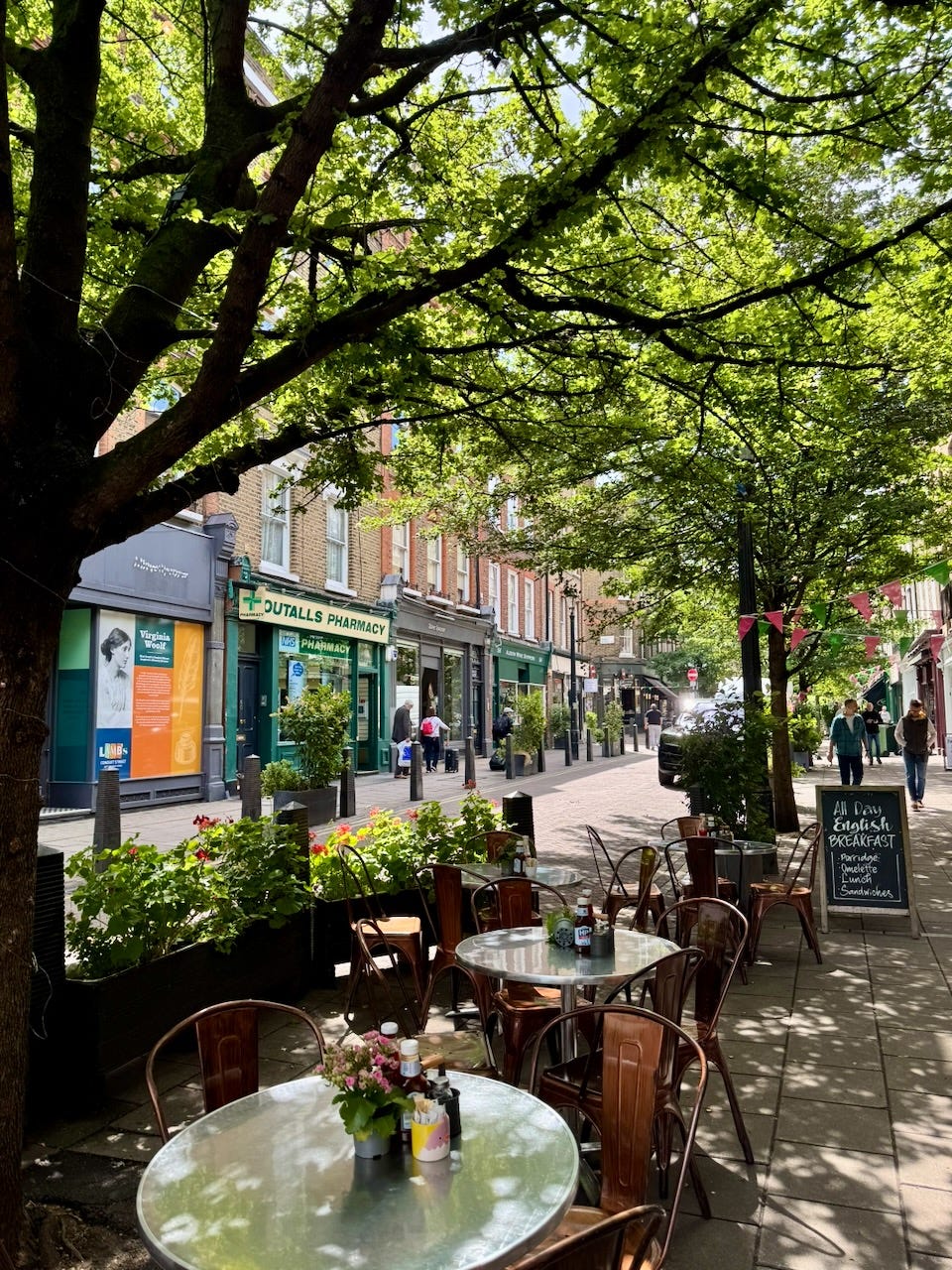
Dystopian food media was a theme of the week.
It started with a cri du coeur from food writer Anastasia Miari: “I am completely in shock and REELING this week after seeing a food influencer I previously really respected being paid by an A.I. company to use their influence to push people towards using A.I. to host dinner parties.” Miari appended a screen grab from the person’s Instagram reel but did not name names (libel laws are different in Britain). Still, it wasn’t hard to find the original post with a quick (yep) Google search. In the action, the influencer uses Gemini to gin up ideas for a tablescape for her beach-themed dinner party. The results are inexplicably bizarre, really comically disorienting in their lack of cohesion and allure. It’s possibly a clever sleight of hand, a way for said influencer to subvert the narrative and still collect the fee. But let’s just say that next time Gemini tells you to put a whole peach on a scallop shell, run.
Still reeling…
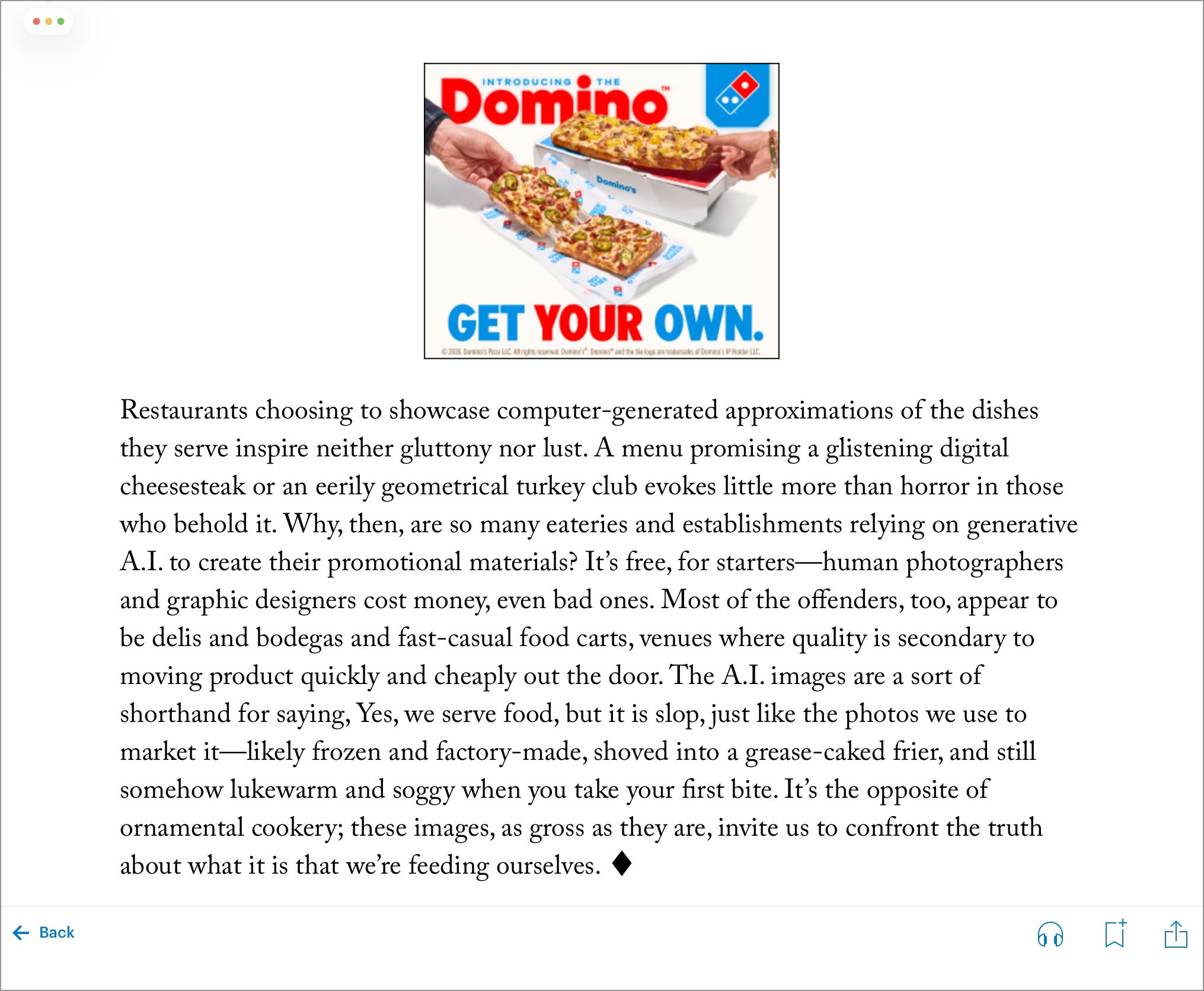
…I read Brady Brickner-Wood’s piece in The New Yorker, “The Unique Horrors of A.I. Food Slop,” a critique of restaurants using A.I. to fabricate everything from menus to marketing. “Restaurants choosing to showcase computer-generated approximations of the dishes they serve inspire neither gluttony nor lust,” he writes. “A menu promising a glistening digital cheesesteak or an eerily geometrical turkey club evokes little more than horror in those who behold it. Why, then, are so many eateries and establishments relying on generative A.I. to create their promotional materials?” He makes a persuasive case that the application of hyper-gloss strips food of its raw visceral appeal, and that menu planning by A.I. risks serving diners whole peaches in lieu of seafood. The freakish kicker landed as the magazine’s ad network coughed up, at the end of the article, a promo for Domino’s pizza. It looks like slop to me; you be the judge. Only the revulsion is real.
The food influencer is dead. Long live the food influencer.
“Instagrammers have upended the British restaurant scene, and amassed followings in the millions. But has their moment already passed?” That’s the opener for a long narrative journalism piece in The Guardian by Stephen Buranyi, the paper’s deputy opinion editor. Buranyi catalogues the rise of the food influencer, their chummy partnerships with PR firms, and their efforts to spin free meals into thousands of Likes. Surprisingly, restaurant influencing isn’t a lucrative gig. Some people have landed brand partnerships of four or five figures, but they usually get far less, or nothing at all. (There’s also rampant speculation about payments under the dining table.) Hospitality businesses don’t demand a positive review, but no influencer bites the hand that’s fed them. That’s become a problem. “[E]very PR I spoke to off-record said that the heyday of the influencer was already over—even if the influencers themselves didn’t realise it,” Buranyi writes, adding that “influencers doing too much positive content and too many paid advertisements had damaged their perceived trustworthiness.” What’s the antidote? Criticism, naturally. “The only way back—the only way to win real trust,” one source told him, “was to rediscover the ideal of being a critic: expert… opinionated, and accountable to no one but the viewer.” Sound familiar?
The restaurant is the story is the restaurant
There’s something deliriously recursive about a hospitality consultancy publishing a Substack about hospitality companies publishing Substacks, but welcome to metamodernity, please make yourself at home. In Crown Creative’s Hospitality Everywhere, Bodhi Landa looks at three case studies of properties that are spinning up media verticals not as advertising, per se, but as another way to articulate their aesthetics and values. (None of them are Crown’s clients, by the way. “We’re just fans,” Nikki Lauri (Freihofer), their brand strategist, told me via DM.) “A restaurant used to have one product: the meal. Everything else (the PR, the email marketing, the physical merch) existed to sell that product,” Landa writes. Now, with the launch of a newsletter, the restaurant has “two products that run in parallel. One is edible and happens in a room at a specific time. The other is readable and happens in your inbox whenever you open it.” That portion of the restaurant’s offerings can now be consumed asynchronously: with breakfast, on the train, whenever the curious customer has bandwidth, literal and figurative. It’s a way to give a restaurant a voice, to make it literally legible. Still, someone’s got to write the thing, which means hiring an editor or fingering a busy staffer who has that resonant voice. It’s harder than it sounds.
Speaking of taste
A while back my friend Terry Theise reached out to me and a handful of fellow wine writers to ask whether, and how, our palates had changed over time. He was interested in shifts both somatic and aesthetic, modulations not only to our physical sensorium but how we interpret its signals. His questions prompted me toward further reflections, which I published here in the essay Taste of Change. Terry’s own article recently appeared in print in The World of Fine Wine, and it’s just been put online. None of his other correspondents—Jon Bonné, David Schildknecht, Andrew Jefford, Peter Liem, and Karen MacNeil—reported significant changes in their palates, a result I had not anticipated. My own experience has been one of continual reinvention, propelled by the co-evolution of my ability to articulate and frame those sensations in language. Terry feels similarly, concluding that “we can’t isolate the question of (capital-T) Taste from the language by which we receive and describe it.” Which pretty much sums up my current life’s work.
See you next week.
Images ©2026 Meg Maker
A potent theme for today's "Salt." And excellent photos, but the one labeled "Just before Service," if true, lacks the elements that make 'just before service" real -- glasses, napkins and utensils on the tables. & btw, why "The Salt" as the title for this feature?