


Welcome back to Notable, where twice a month I reflect on the best wines of recent tasting.
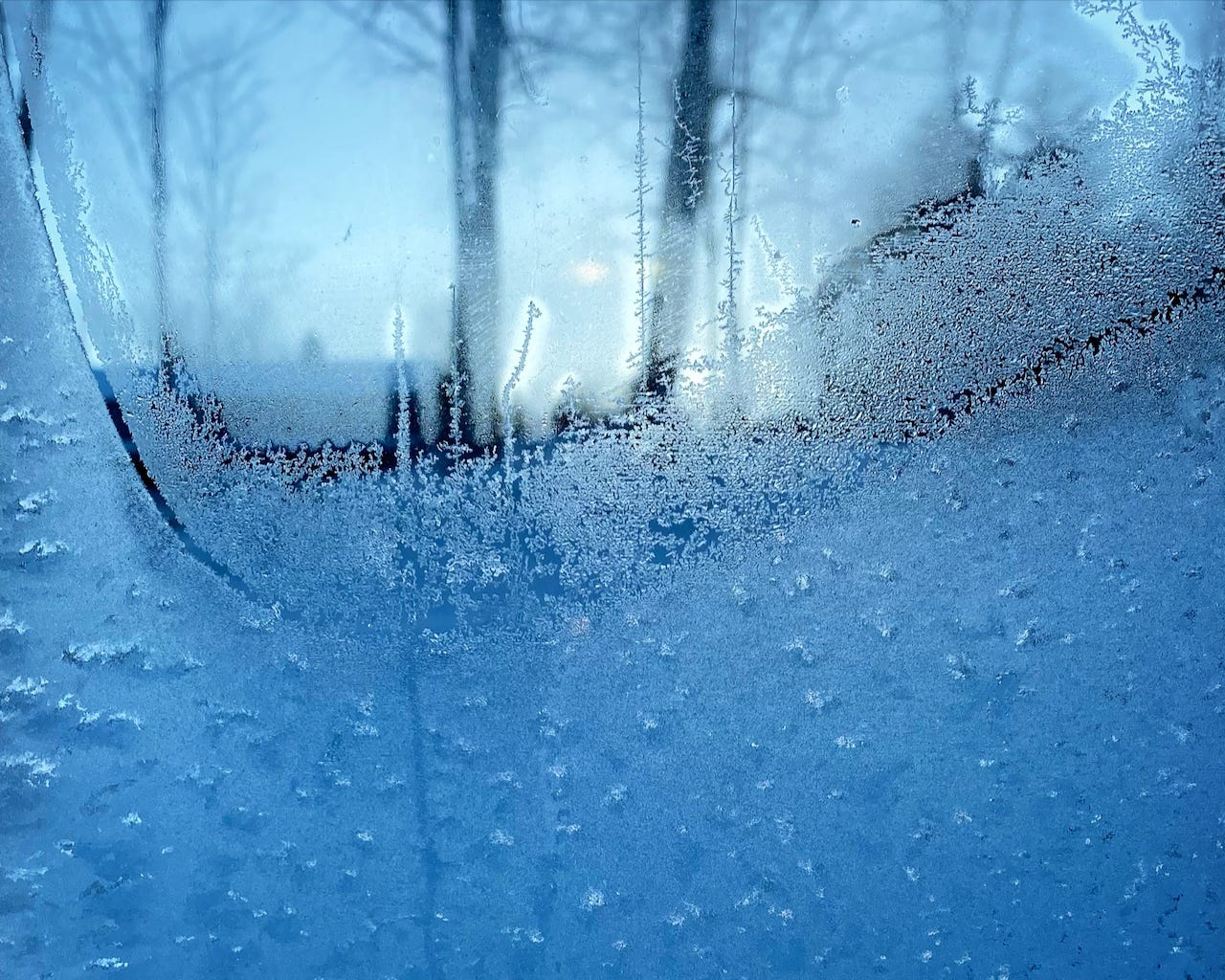
Last week the Northeast was hit with a paralyzing blizzard. Arctic air collided with continental moisture to smother the region with a foot and a half of frigid snow. Travel was nearly impossible, and those who ventured onto roads did so at their peril; several local accidents involved the plow trucks themselves. It has remained bitter cold, well below 0°F overnight and scraping single digits during daylight, so we are still blanketed in the refrigerated remains of this storm.
Everyone’s cold and hungry. Our yard is crisscrossed with the tracks of woodland creatures, a palimpsest of their ceaseless expeditions in search of nourishment. Yesterday I watched a red-tailed hawk dive at three gray squirrels foraging in our old Christmas tree, which I stake out as a makeshift bird feeder. A few days earlier I’d seen a large bobcat policing our perimeter, and overnight the animal visited the tree, hunting the meadow voles who tunnel for seeds dropped by busy birds. Although I’ve no hard proof it was the cat, not a deer or coyote or fox, I believe it was him by his track: no paw prints per se (the snow’s too deep and fluffy), but instead a trough just cat-wide and cat-deep where he’d dragged his hungry belly.
It’s hard not to see “paralyzing storm” and “survival in extremes” as a metaphor for our country’s moment. (Not to mention “waiting for ice-out.”) And it’s hard to commit to writing about wine when that’s not what’s keeping me awake in dark hours. Given the magnitude of the current struggle, wine, and wine writing, seem laughably irrelevant. But I also don’t see that self-censorship, tools down, would be helpful while speech is under attack. Plus, one of the things we’re rooting for is comfort and safety, the ability to nourish and feed ourselves. Those aren’t just creature comforts—although all creatures need them—they’re needs both literal and figurative. Wine helps fill the void and, for me, so does the writing about it. So, I press on.
Notable Wines
Below are my reports on a 1990 Cos d’Estournel, an old-vine Chinon from Olga Raffault, a rare varietal Nerello Cappuccio from Benanti, three elegant Prosecco Superiore from La Farra, and three traditional method sparklers from Scharffenberger. Levity for cold, dark times.
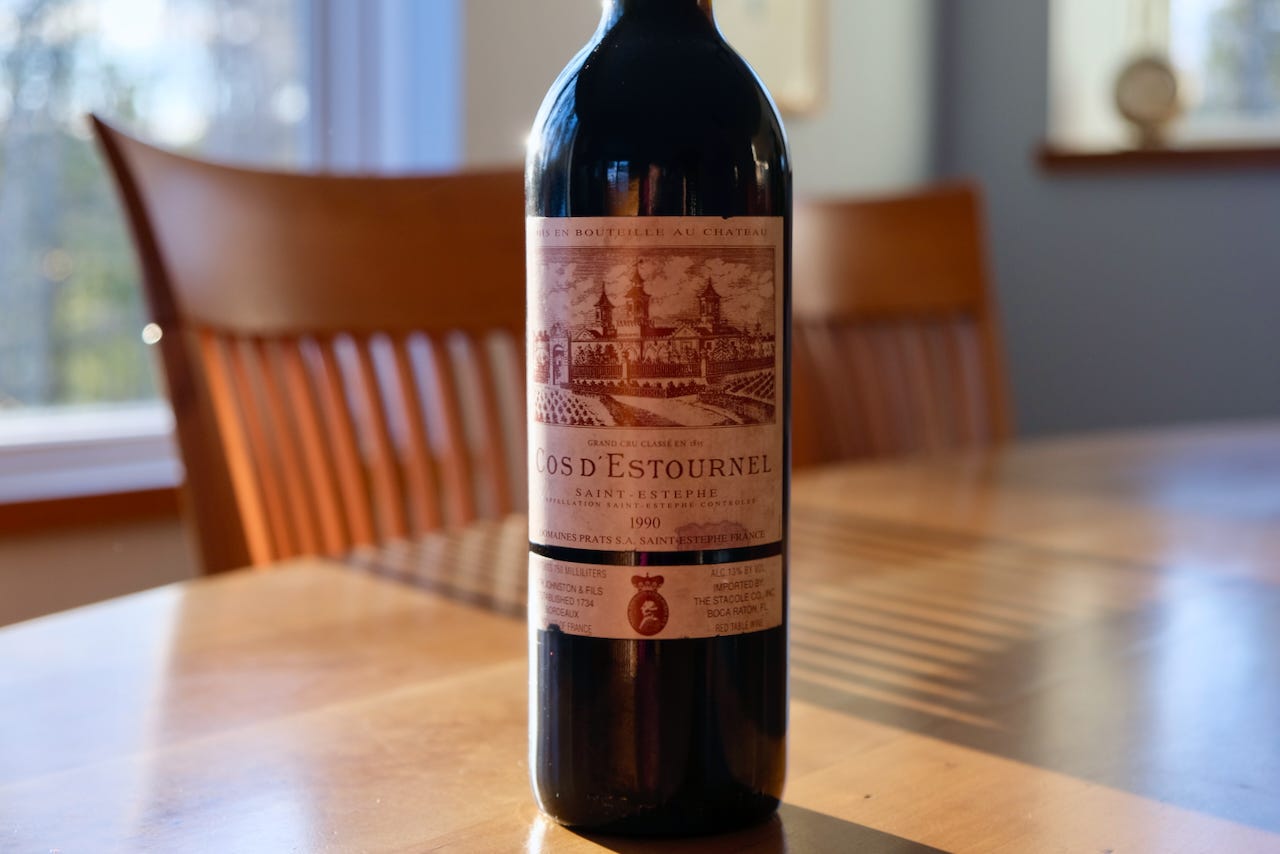
Cos d’Estournel Saint-Estèphe 1990
A friend with a deep cellar read my recent posts about tasting the 2015 Cos d’Estournel and the 2018 Pagodes de Cos, the producer’s second label, and offered a taste of his 1990. He’d purchased it off the shelf in 1992 or 1993 at a private shop in Washington, D.C., and stored it in his cold Vermont basement.
The 1990 Bordeaux vintage was hot and sunny, like 1989 but drier, and two torrid summers in a row had stressed the vines. According to Robert M. Parker Jr., in his Bordeaux guide (3rd. ed., 1998), vineyards with heavier, moisture-holding soils fared best in 1990, particularly those in St.-Estèphe, Fronsac, and portions of St.-Emilion. But vineyards planted in lighter, gravelly, well-drained soils, like those of Margaux and the Graves, struggled in the heat, and many producers were compelled to pick earlier than desirable lest the grapes desiccate on the vine.
The best Bordeaux wines from 1990 were fruit-forward and concentrated, and—surprise!—Parker loved them. He called it the best vintage since 1982, which in his view had been “the modern-day reference for the greatness Bordeaux can achieve.” Parker especially liked what Cos d’Estournel, a St.-Estèphe estate, had achieved in 1990, and rated them among his top producers for the vintage. In December 2001, he re-tasted the 1990 Cos and declared it ready, with fifteen years of life ahead.
We’ve overrun Parker’s runway by about ten years, and the wine was showing its age but was still enormously pleasurable. Deep amber red, its robe was tea-stained and shrouded with abundant tartrate sediment, a signal that the tannins had softened. The wine’s texture was diaphanous, drifting off in a whisper. A sense of nut and violets and fresh tobacco wreathed the wine, and flavors of red berries and coffee anchored its midsection. The fruit was no longer opulent and concentrated but attenuated and ethereal. The texture, for me, won the day.
13% ABV | This vintage is currently available at various U.S. merchants for about $350; the wines are currently imported by Millesima
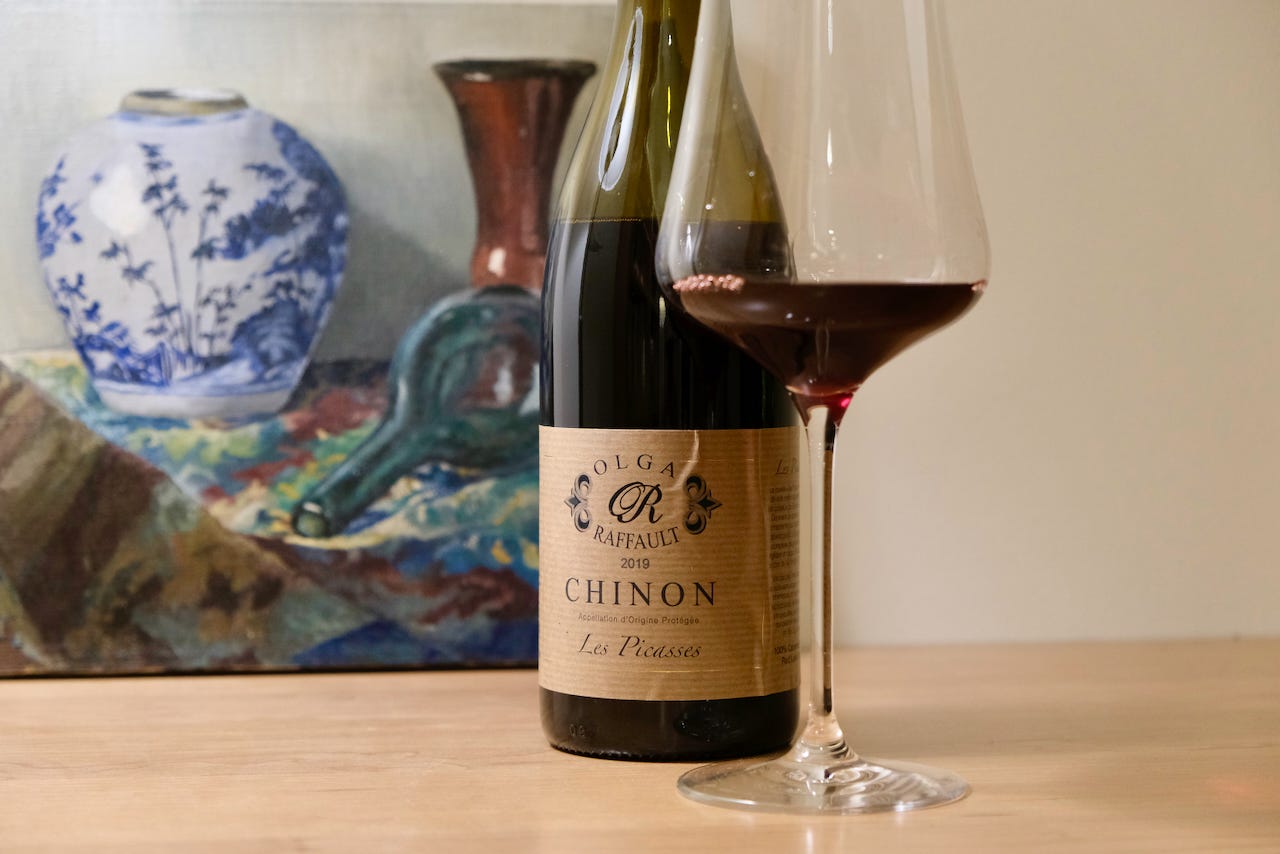
Olga Raffault Les Picasses Chinon 2019
Olga and Pierre Raffault farmed a site near the Loire and Vienne Rivers. When Pierre died suddenly, in 1947, Olga was left with two small children and fruit hanging on the vines. She was able to enlist the help of Ernest Zeinninger, a former German prisoner of war who’d been in service to the estate. He went on to make the wine for many years, tutoring the Raffaults’ son, Jean.
Today Jean’s daughter, Sylvie Raffault, along with her husband, Eric de la Vigerie, and their son, Arnaud de la Vigerie, manage production. The estate has 24 hectares in vine, 23 of which are Cabernet Franc for Chinon Rouge and Rosé, with the remaining hectare planted to Chenin. Farming is certified organic, and the winemaking is old-fangled.
“Les Picasses” is a plot of fifty-plus-year-old vines. The wine spends two to three years in oak tanks and is usually released four years after the vintage. It is profusely aromatic, sylvan, wild smelling, a mélange of feral fruits and flowers with a leathery, tea-like fringe. But it also feels completely alive, with focus and shiny acidity. It’s fully mature, concentrated, and sophisticated but also playful.
13.5% ABV | About $30; Imported by Louis/Dressner Selections, LDM Wines Inc.


Benanti Nerello Cappuccio Terre Siciliane IGT 2021
I’ve written previously about my visits to Benanti winery, in Viagrande on the southeast slope of Etna (find a full tasting report here and the Etna Rosso in a recent Notable). This wine is 100 percent Nerello Cappuccio, a grape native to Etna but almost always blended with Nerello Mascalese, the volcano’s more famous red grape. Cappuccio brings color, acidity, and fruit flavors to the blend while moderating Nerello’s grippy bite. Benanti first bottled it as a varietal wine in 1998.
I love this wine, but I can understand why most winemakers would blend the grape; in lesser hands Cappuccio as a monovarietal might feel too delicate, even vaporous. Benanti’s wine is lissome but not without substance. Its fragrance mingles roses with spearmint, sea air, and smoke. The first sip offers pleasing fruit, then the wine seems to vanish for a moment before it rushes back with flavors of rare meat and violets, anise and orange peel. Much later, I got a hit of cinnamon. Yes, a lot going on, but it’s a lovely glass of wine, and given its rarity a privilege to taste.
13.5% ABV | About $36; imported by Wilson Daniels, Inc.
La Farra Prosecco
Prosecco has a bad rap in the U.S. The criticism is mostly well earned, since the overwhelming majority of the stuff sold here is utterly characterless. But better Prosecco does exist, grown in Asolo or in the hilly zone between Valdobbiadene and Conegliano, where vineyards stripe the chunky “hogback” hills. There the Glera vines struggle more than in the fertile Venetian lowlands (the source of the uninspired fizz), and struggle builds character. The terrain also demands hand cultivation, and handwork means producers must pay attention.
Certain designated regions in this zone, called rive, produce the highest quality grapes, and producers are permitted to put named rive on the label alongside the protected designation of origin, Prosecco Superiore DOCG. Glera, the grape, originated hereabouts and was, until 2009, called Prosecco. That was the year the DOCG was approved, and the name was changed to eliminate confusion between the grape and the legally demarcated region. It also allowed the Italians to go after anyone outside of Italy using the Prosecco name for Prosecco-grape wines (although the Australians, in particular, largely ignored their entreaties).
I’ve visited Conegliano-Valdobbiadene and Asolo several times to taste the Superiore wines. The best have a fine, pearly bead, aromas of white flowers, and flavors of stone and pome fruits. Although made in styles from bone dry to sweet, much Superiore is Brut, making it a fine aperitif that can also slide into the meal.
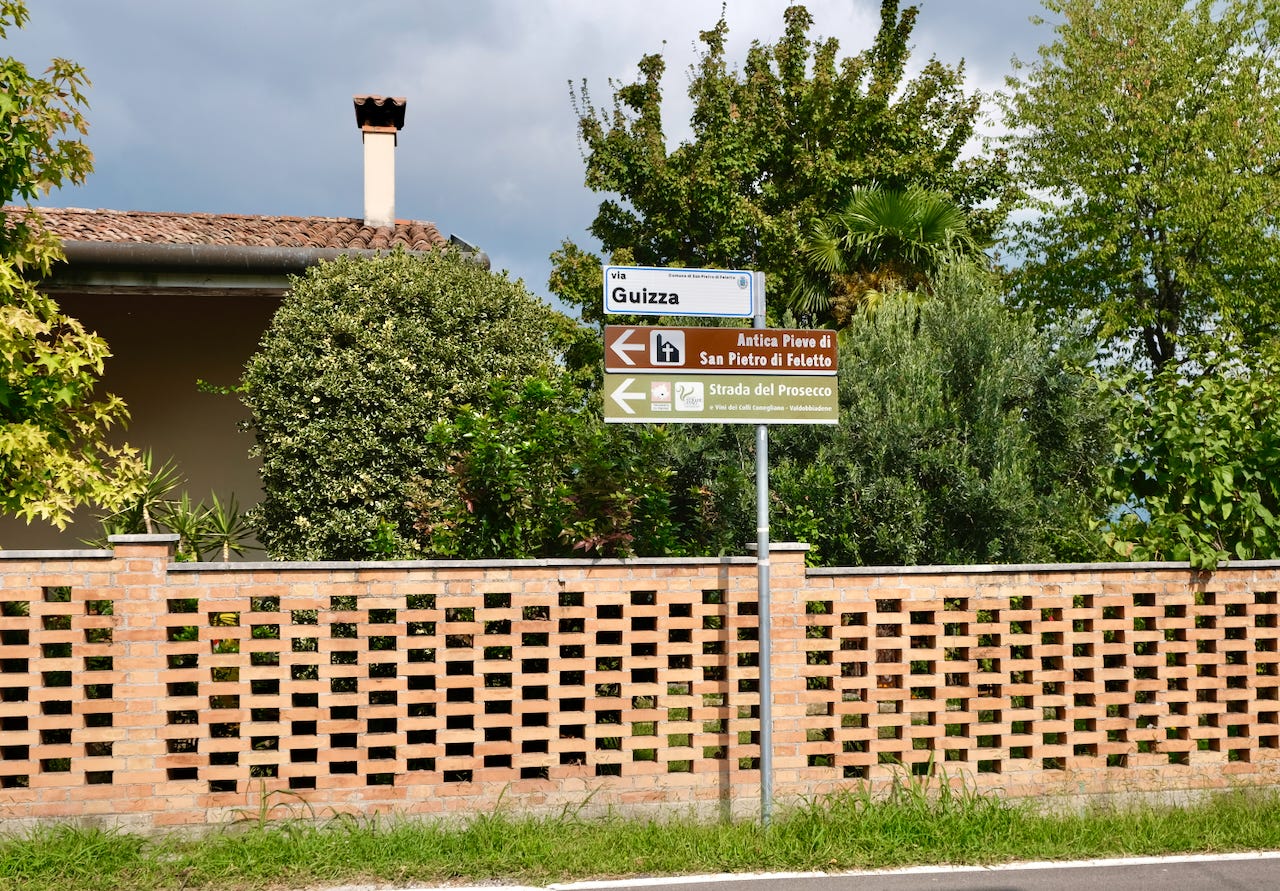
Recently I tasted a trio of Prosecco Superiore from La Farra. The company is run by Adamaria, Innocente, and Guido Nardi, siblings who took over from their father, Gian Domenico Nardi, in 1997. They farm about 25 hectares in Conegliano-Valdobbiadene, including plots in the rive of Farra di Soligo, Pieve di Soligo, Follina, and San Pietro di Feletto. Farming is SQNPI certified.


La Farra Brut Valdobbiadene Prosecco Superiore 2024
Pale, elegant, dimensional. The fizz from the pour quickly settles into a quiet bead. There is a sense of bread, white flowers, and white orchard fruits, with a finish like pear nectar. Seamless, balanced, no elbows or knees.
11% ABV| About $19 (sample)
La Farra Extra Brut Rive di Farra di Soligo Valdobbiadene Prosecco Superiore 2024
A rive wine, Extra Brut. Pale and delicate, it has a fragrance of bread, apple, pear, and spring flowers. Its texture is fine and pearlescent, carrying flavors of ripe pear, both skin and flesh. It finishes clean, almost bracing, but the fruit lingers. Elegant and refined.
11.5% ABV | About $20 (sample)
La Farra Extra Dry Rive di Farra di Soligo Valdobbiadene Prosecco Superiore 2024
The same wine but Extra Dry, the sweetness not distracting but instead more like a yellow highlighter on the pear and apple fruit. It smells riper, fuller, but still finishes clean.
11.5% ABV | About $20 (sample)
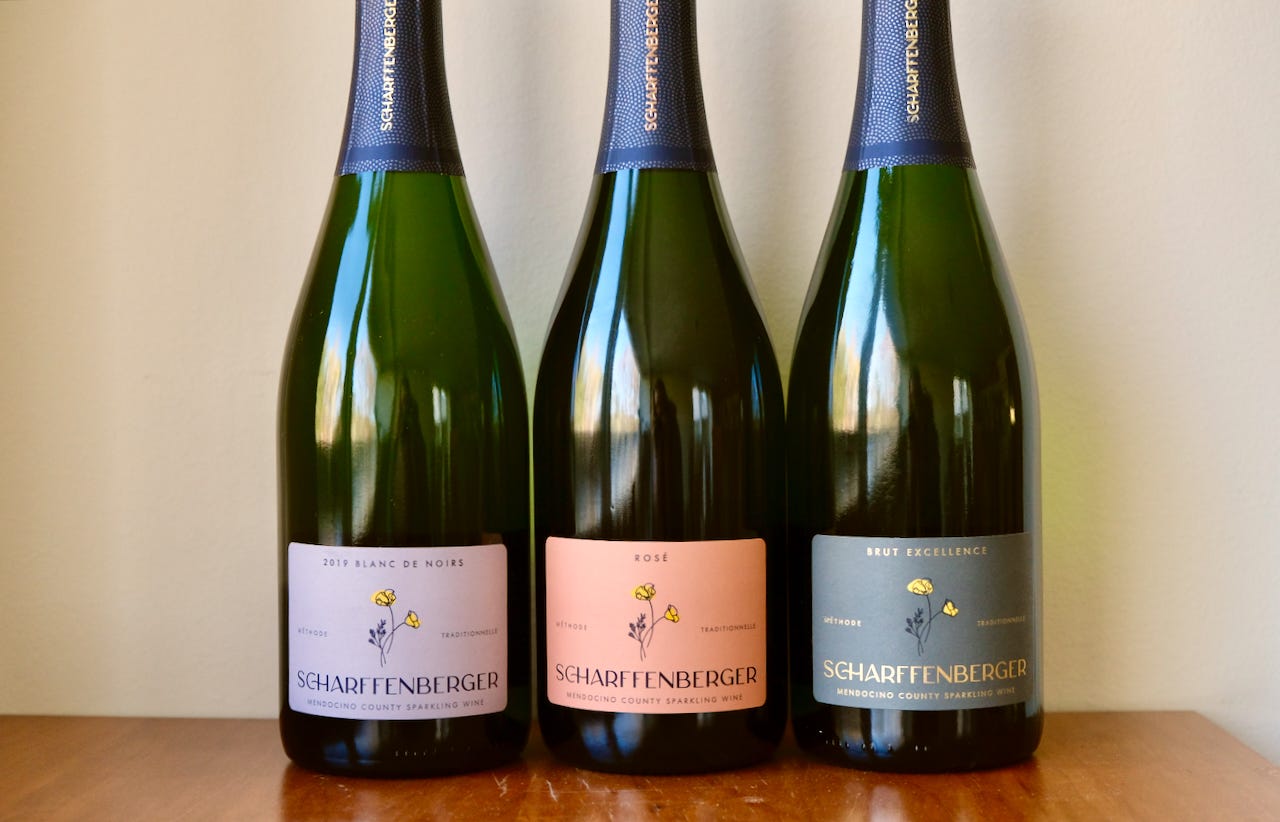
Three Scharffenberger Sparklers
We pivot to another sparkling wine producer nearly half a world away, in California’s Anderson Valley.
In 1973, John Scharffenberger was a fresh graduate of UC Berkeley with a major he’d cobbled together from courses in soil science, botany, geology, and landscape architecture. That year he purchased a 1,255-acre ranch in Mendocino County and started to plant it to vines. His single goal was to produce traditional method sparkling wines, and over the next decade, while his site matured, he worked at a handful of wineries and took classes at UC Davis to build his skills.
The first vintage of Scharffenberger Cellars was 1981, with winemaking in a warehouse space in Ukiah. By 1989 Scharffenberger had enjoyed enough success to catch the attention of the parent company of Champagne Pommery, and their fresh investments let him buy new property and build a new winery facility in Philo. It opened in 1991, the year John turned forty.
But four years later, in 1995, Scharffenberger completely exited the wine business. He sold his stake to the French parent and pivoted to another luxury industry, launching Scharffen Berger Chocolate. He and his business partner sold that company to Hershey ten years later.
In 2004, The Roederer Collection acquired Scharffenberger Winery, and today Jeffrey Jindra is winemaker and Bob Gibson directs vineyard operations. The 120-acre estate is sustainably farmed. A hallmark of the Scharffenberger style is the use of about 12 percent reserve wine in the nonvintage cuvées, plus the fact that about 80 percent of lots go through malolactic conversion. These techniques add toasty, nutty, and caramel notes that can be overpowering if the acidity and texture aren’t in balance.
When I’ve tasted these wines in the past, I found those notes distracting, but these three bottles changed my mind. They felt charming: accessible, friendly, and well priced. They’d be good choices for a wedding or shower or picnic or lawn party or fill-in-the-blank festive gathering where you want an affordable sparkler that doesn’t scream Look at me, it just says Drink me.


Scharffenberger Brut Excellence Mendocino County NV
A 60/40 blend of Chardonnay and Pinot noir with a dosage of 8.5 g/L. It smells like pastry and marzipan and tastes like red and yellow apple, toasted almond, and caramel. But it also has a kind of grippy, woodsy seriousness that grounds it. It finishes round and fruity, lightly ambrosial. Just the right side of not too sweet.
12.5% ABV | $24 (sample)
Scharffenberger Rosé Mendocino County NV
Pale shell pink, quite pretty, the color achieved from adding 4 to 5 percent Pinot noir prior to bottle fermentation. The finished blend is 55 percent Chardonnay and 45 percent Pinot noir, and the dosage, like that of the Brut Excellence, is 8.5 g/L. It’s fragrant of strawberries, pastry, marzipan. It’s open-textured, as is the Brut, with melodious berry fruit and a touch of cream and almond.
12.5% ABV | $30 (sample)
Scharffenberger Blanc de Noirs Mendocino County 2019
This vintage blanc de noirs is a blend of 40 percent Pinot noir, 33 percent Pinot gris (stretching “noir” a bit), and 27 percent Meunier. The dosage is slightly lower, at 8 g/L, and the metrics for titratable acidity and pH reveal it to be a sharper wine. The mousse is busy, active, and the wine offers scents of lime and cherries. The flavors are likewise fruity but its acidity feels bracing and breezy. Touches of toast and marzipan add depth, but overall it’s cleansing, cooling, fresh.
12.5% ABV | $40 (sample)
All photos ©2026 Meg Maker. Some wines (indicated) were samples for review.
Now I am checking WineSearcher for the Proseccos.