


Jurançon (zhoo-rahn-SOHN) is an appellation in southwestern France, in the bumpy foothills of the Pyrenees, producing dry and sweet white wines from indigenous grapes.
The dry wine, Jurançon Sec, is crisp and aromatic, with flavors of ripe stone fruit and spice. The sweet wines, Jurançon and Jurançon Vendanges Tardives, or late harvest, are the main attraction, produced by a process called passerillage (pah-seh-ree-YAZH) in which bunches are dried on the vine, desiccating and concentrating sugars.
Jurançon’s history
Wine has been produced in Jurançon since the Roman times. By 1385, a regional census cites it by name, “juransoo,” and by 1562 a text in Occitan provides the first mention of the regional Manseng grape, “vinhe mansengue.”
Legend has it that at the 1553 baptism of Henry IV, the infant’s grandfather daubed a few drops of sweet Jurançon wine onto his lips, then rubbed them with fresh garlic for good measure, ostensibly to strengthen his body and mind (it’s anyone’s guess which substance did what).
By the mid-16th century, Jurançon wines were becoming famous across France, later catching fire in Holland and eventually enjoying robust export across the Atlantic. Phylloxera devastated the vineyards in the late 19th century (as elsewhere in Europe), and the region only began to recover during the interwar period.
The French writer Colette, née Sidonie-Gabrielle Colette, gave it a boost in her essay Vins, published in Prisons et Paradis in 1932: “Je fis, adolescente, la rencontre d’un prince enflammé, impérieux, traître comme tous les grands séducteurs: le Jurançon” (“As a teenager I met a passionate prince, imperious, treacherous like all great seducers: Jurançon”). I’ll have what she’s having.
In 1936, the Jurançon sweet wine AOC was established, one of the earliest in France. Jurançon Sec followed in 1975 and Vendanges Tardives AOC in 1994. Today, according to the professional council Les Vignerons du Jurançon, the region has 65 independent producers farming 620 hectares (1,530 acres) of vineyard.
Jurançon terroir
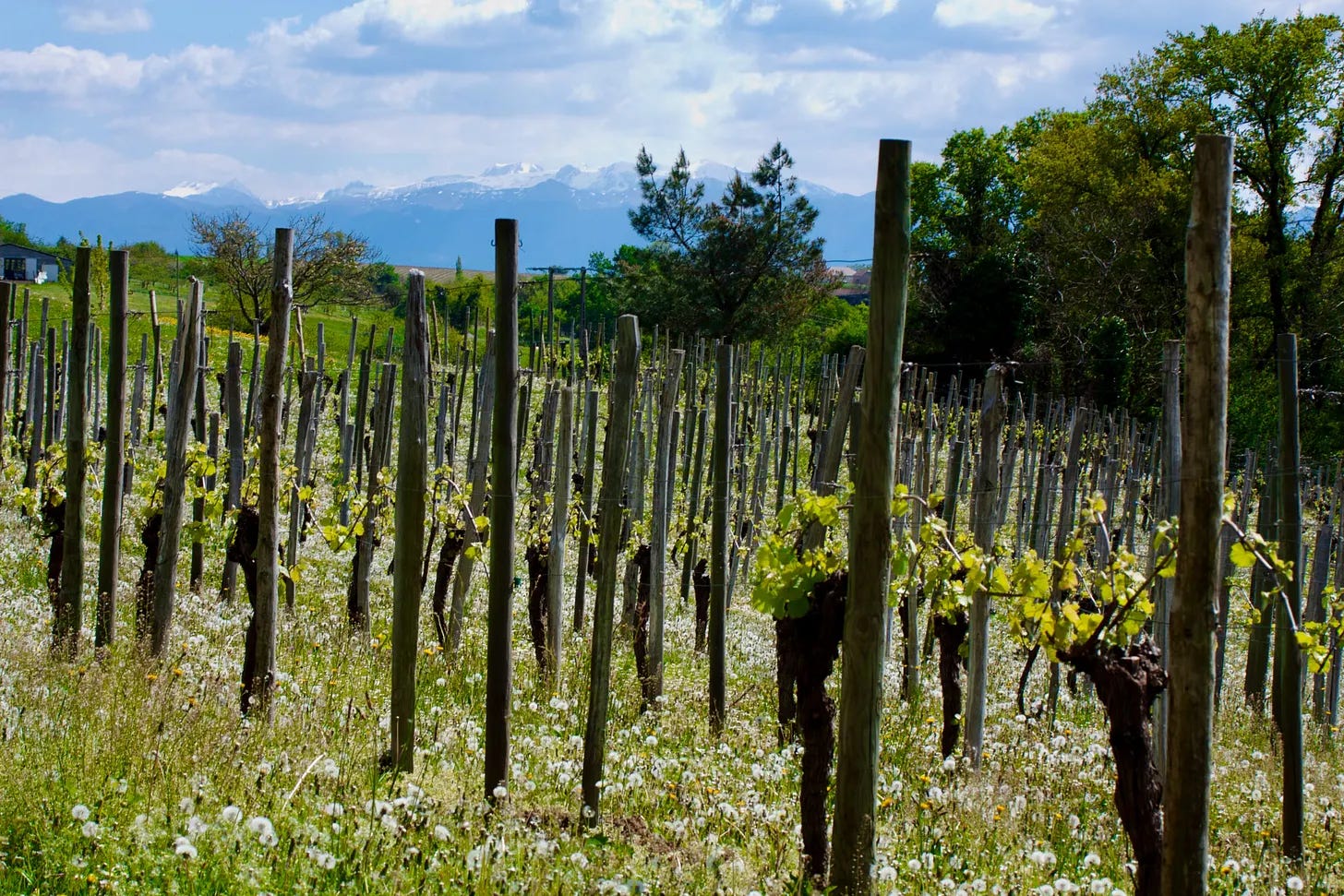
The Jurançon region is warm but tempered by moist Atlantic air that also guarantees 1,200 mm of rainfall each year. The foehn (feun) wind that drops down from the mountains keeps grapes healthy and hastens the drying process. Harvest dates for the sweet wines are among the latest in France, starting in mid-October and stretching into December.
The vines are planted as high as 300 meters a.s.l. and are sometimes trellised in the local hautain (oh-TAHN) style, similar to espalier, which elevates the canopy to prevent damage from spring frosts.


The grapes of Jurançon
This is a territory where indigenous grapes dominate, principally Gros Manseng (gro mahn-SENGH) and Petit Manseng (peh-tee mahn-SENGH), along with minuscule quantities of the nearly extinct Courbu, Petit Courbu, Camaralet, and Lauzet; all are white varieties.
