


American wine has lost its mojo. So say the headlines. Older wine customers are aging out, younger customers are looking elsewhere, and discretionary spending is stretched to the limit. The industry struggles with oversupply, economic downturn, and lackluster engagement. Those still buying wine want assurances of pleasure and fewer but better experiences, emphasis on experiences.
There are glimmers of hope. Rob McMillan, author of the 2026 Silicon Valley Bank State of the U.S. Wine Industry report, thinks American wine has endured the steepest declines and is entering a period of correction. He predicts better times in 2027 and 2028.
But while the industry itself will survive, individual producers might not. “The recovery that follows will favor those already executing outward-facing, consumer-driven strategies,” he writes. Wineries that reorient their efforts toward keeping top customers, streamlining their SKUs, and avoiding risky experiments are the most likely to make it through. Those with a strong tasting room game are in the best position, because “hospitality and experience remain the bedrock.”
That’s good advice for existing brands with strong engagement, attractive venues, and enough fat to trim. But what about a new winery or region that has yet to find its footing? At the recent annual meeting of the Vermont Grape and Wine Council, these questions floated like ghosts in the room.
Vermont’s wine culture is so young it hasn’t had time to develop immunity to the economic maladies plaguing the American wine industry. Vermont’s wineries are principally family operations, many first-generation. Volumes are small, costs of production are high, and principals wear many hats, from pruning to production to sales. Many work organically or naturally, requiring significant labor that further drives cost. The industry enjoys less regulatory clout than more established Vermont ag sectors like maple and dairy. And the hybrid grapes planted here are, to consumers, at best unfamiliar and at worst mistrusted.


Nonetheless, Vermont wine producers make a significant contribution to the state’s economy. According to the 2025 Vermont Wine Impact Study, the two-dozen wine producers, farming just 200 acres—the area of a single dairy farm—generate $687 million of economic activity. Wine tourism and hospitality play an outsized role in that total, especially in the ski towns of central Vermont and in the scenic Champlain Valley, where much of the state’s wine is grown and made.
That figure is at risk as Vermont’s $4 billion tourist economy fell off the cliff in 2025 after protectionist policies precipitated a 30 percent drop in Canadian border crossings and 50 percent drop in Canadian credit card spending. According to Vermont Business Magazine, “This dip is felt most significantly at restaurants, campgrounds, inns, marinas, retail stores, and festivals.” Put “wineries” onto the list.
Getting Vermont wine into Vermont hospitality businesses, especially those with a farm-to-table ethos, is crucial for future success. Most wineries run small tasting rooms, but reach expands significantly when the products land on wine lists and by-the-glass programs at Vermont’s busiest enterprises. Hospitality businesses are where wine-loving customers enjoy those vital experiences. Awareness grows demand. Demand grows brand. Brand grows business.
Vermont wineries are legally allowed to work directly with retailers and restaurants, bypassing distributors and the cut they take of the sale. That nets them more revenue and is a great way to demonstrate in person how hybrid wines, grown in Vermont, work with Vermont cuisine. But distributors are still part of the mix, because it’s time consuming for a producer to schlep their wine across the territory and build their own relationships with buyers at shops, restaurants, and wine bars. Success also demands an understanding of what motivates those professionals: their needs, constraints, and aspirations.
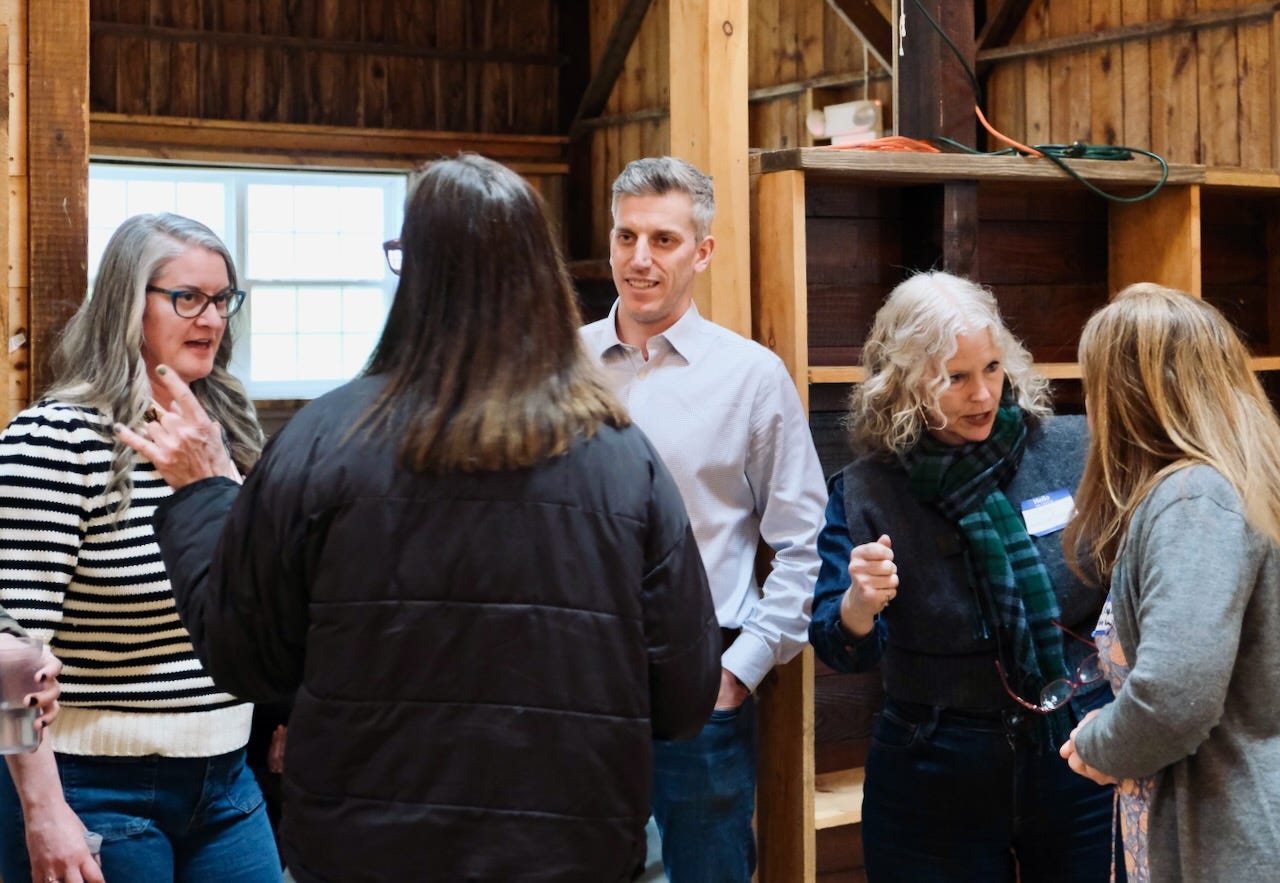
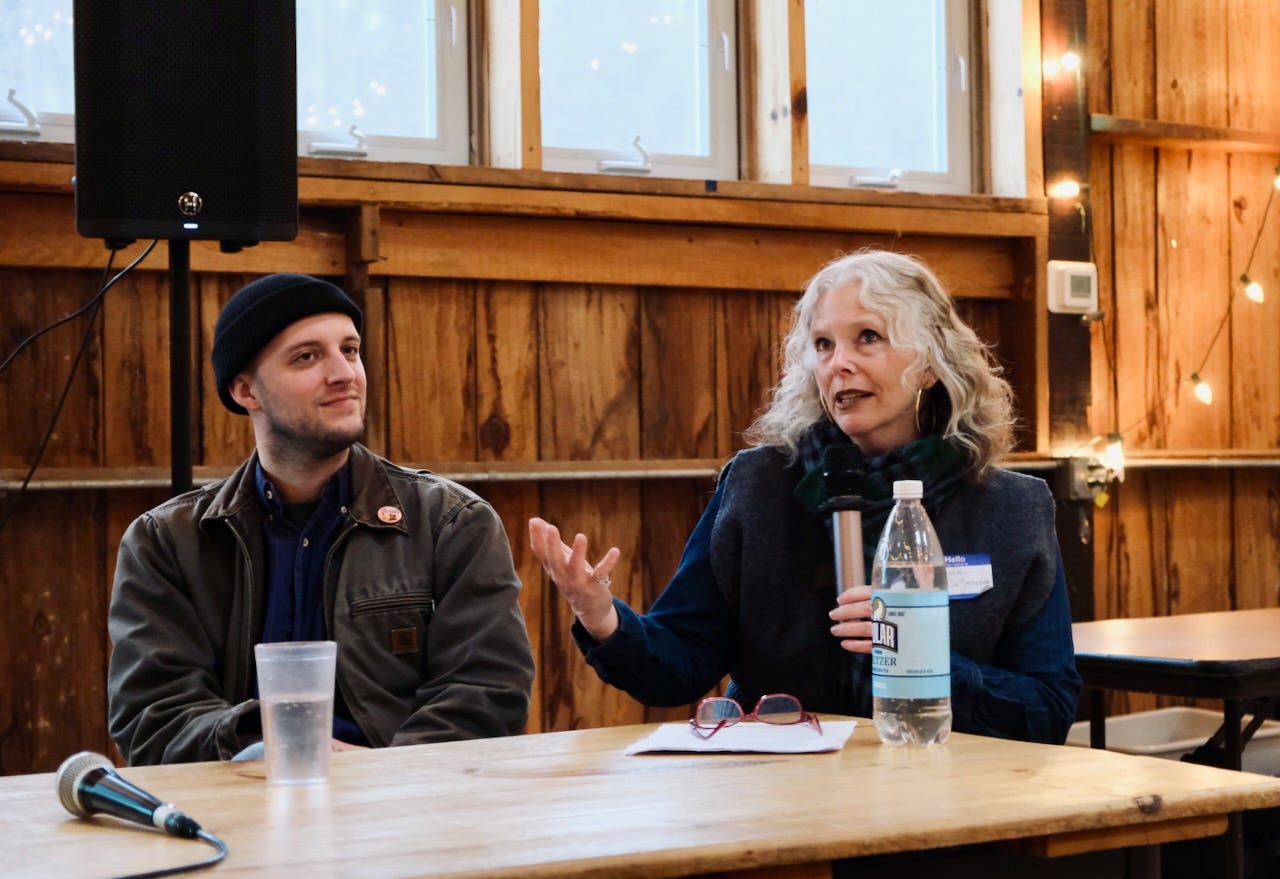
VGWC’s annual meeting put working with hospitality front and center during a panel discussion called “Grape to Glass,” moderated by Deirdre Heekin. She is vice president of VGWC and co-owner, with her husband, Caleb Barber, of La Garagista farm and winery. I first met the couple twenty years ago at their tiny restaurant, Osteria Pane e Salute, in Woodstock, Vermont. Caleb cooked and Deirdre ran the front of house, acting as host, somm, and (notably) wine buyer. Around that time they started planting vines at their home in Barnard, later adding a vineyard in the Champlain Valley. Today the winery is their full-time gig, and they have built a sterling international reputation for natural wines made from hybrid grapes. They’ve also been a key force in growing and promoting Vermont wines, in part by helping their stagaires develop and launch their own independent brands.
For the panel, Heekin recruited wine buyers from three important Vermont hospitality businesses. Logan Patnaude is general manager of Salt & Bubbles Wine Bar and Market, which is focused on ethically made natural and small-production wines. A Vermont native who worked in the wine industry in Oregon, he recently returned home to run this buzzy property in Essex Junction. Kate Wise is bar lead at Juniper Bar and Restaurant, located within Hotel Vermont in Burlington. Her program landed her on the list of the 2026 James Beard semifinalists for Outstanding Professional in Cocktail Service. Jackson Strayer-Benton is director of food and beverage for Heirloom Hospitality Vermont, which has five properties, including Vermont farm-to-fork pioneer Hen of the Wood, brewery and restaurant Prohibition Pig, and Doc Ponds bistro.
Heekin asked the panel, “What’s the status of Vermont wine in Vermont hospitality?”
Strayer-Benton did not mince words. “Shit’s hard, that’s the reality.” In the last two years, he’s seen costs of both goods and labor skyrocket. He’s had to look at how he can offer Vermont wines with assurances the inventory won’t languish, since they cost him about the same as the mid-tier European wines that turn more reliably. “Europe is easy to sell: France, Italy, Spain, Austria. Sancerre sells at a very high rate,” he said. Plus, he’s kind of over natural wine, at least from a business perspective. “That was fun, but I want something clean and consistent if I’m going to spend money on it. I want it to be expected. Are Vermont wines consistent?”
Patnaude said Salt & Bubbles likewise sells far more European than American wine. But given their local-natural focus, he strives to keep at least two Vermont products on his small BTG list. Wine flights make up a majority of his sales, and although he takes less margin on them, only 18 percent over retail, it’s easy to slip a local wine made from an obscure grape into a four-glass lineup. “With flights there’s less volume in each glass, so they feel lower risk for the client.”


Heekin conceded that a Vermont wine cannot compete, price-wise, with a wine that leaves the European cellar door at €4 and lands in U.S. distribution at $10 or $15. Vermont’s smaller volumes mean there are no economies of scale.
Wise said she is happy support the industry, and puts Vermont wines onto her list at Juniper with the full understanding that she will realize lower margins. But in return she expects cooperation from producers and distributors—someone to visit, show the wines, and tell their story to her team. “We need to be able to taste them. The staff needs to taste them. Someone has to eat the cost somewhere,” she said. For a producer making only, say, 100 cases of a given wine, pouring bottles for businesses across the state eats into the available supply. But, Wise said, “There needs to be three-tier cooperation. If you want your wine by the glass at my bar, we all have to take a hit for the greater good.”
“The more we can get you guys in front of our staff, the more success we’re all going to have,” agreed Strayer-Benton. When winemakers visit his properties, they share not only their wine but their origin story. His servers can carry that narrative straight to the floor, using it to convince a customer to try the wine. The power of narrative holds for both a single winery and the broader Vermont wine culture. “Sell the story. If Vermont wants to sell more than Europe, it has to have its own lane, its own style. Its own storytelling.”
“And there are so many of you!” Wise added. “Without the story behind it, we don’t know how to sell it. No restaurant can carry all Vermont wines. Make yourself known.”
As for storytelling: at this writing, Vermont is poised to earn a new sub-appellation, Champlain Valley of Vermont. That will let both producers and servers speak not only of wine but of place.
Heekin wrapped the panel on a high note, floating the idea of monthly Vermont group wine tastings with hospitality. “Let’s make it happen!”
A week after the meeting, I followed up with Heekin to reflect on the panel and the work ahead, especially in light of the larger American context and the suggestion that survival hinges on building brand, nailing narratives, cultivating customers, and offering memorable experiences. “Let’s make it happen!” is going to take work.
Heekin isn’t fazed. “We have a vibrant food community here, a vibrant restaurant community,” she said. “Vermont wine growers are one-hundred-percent into collaborating and connecting with hospitality.” Plus, “We have not at all saturated the market. There’s room for everyone. It’s easy to travel around to visit people… We should really focus on on our home territory.”
And nobody is entirely on their own. She’s seen—and been part of—the collaborative mindset that will assure Vermont’s success. “Vermont wine is collective,” she said. “The people who are involved really do want to raise everybody up… It creates, I think, a generosity of spirit that is not competitive. Because if somebody else is doing well, it brings more for everyone. I do feel really lucky that as a region we have that kind of solidarity.”
Images except where noted ©2026 Meg Maker. I’m grateful to the Vermont Grape and Wine Council for inviting me to be a guest at their annual meeting.
Well done. And thank you for not saying that Vermont is the next Napa Valley.
I agree with Fredric Koeppel. Shoot, there are a lot of people in Napa Valley who are not happy about what Napa Valley has become.