


Welcome back to The Salt, my roundup of favorite recent writing about wine and food, thirst and hunger.
The Salt is returning from a brief hiatus as I cranked out other projects. Last week I finished a long essay I’d been developing over months, then pitched to a favorite editor. Fingers crossed for success, but if it doesn’t land there at least you’ll read it here. I also hosted a colleague and his wife for a tasting and dinner, logging 17,000 steps, mostly in my kitchen, before falling into bed at midnight. On Tuesday.
This week I presented a seminar for the Wine Scholar Guild which uses Pinot Noir as a lens to look at the evolution of wine writing. It’s a talk I’ve given before using material from a paper I published in The World of Fine Wine, but it still needed tweaking, because (proving my own point) wine isn’t fixed, it evolves.
Plus it’s August, a time of year it’s critical to step away from the screen and into the garden. Right now mine sorely needs me. This spring we added a large outbuilding near the vegetable plot, and by the time the landscapers trundled out it was too late to plant veg and too hot to establish lawn. Nonetheless the team spread a load of pricey loam and hydro-seed, which promptly produced a profusion of witch grass, crabgrass, purslane, pig’s ear, lamb’s quarters, and a handful of species I’ve never seen in four decades working dirt. The seeds were apparently lurking in the loam, and they swiftly overwhelmed the grass seed, which dried out and got eaten by birds.
Lawns are dumb but even dumber without grass, so my spouse and I have been ping-ponging between anger and despair, both especially acute at 3:00 a.m. The landscaper tells us the grass will overtake the weeds come fall, just you wait, but this notion strains credulity. So I have literally taken matters into my own hands, using a spading fork to lift the roots and a weeding hook to pull out the unwanted biomass. I’ve made progress over three or four sessions, and figure I’ve another ten or twelve to go, who knows. At least it’s restored a measure of calm to my psyche. I’m certainly sleeping better, maybe because I’m so damned tired.
So, not much time to write. But I have been reading:
Gourmayto, Gourmahto
Back in January, a group of five food writers acquired the lapsed trademark for Gourmet, the food magazine shuttered by Condé Nast in 2009. After a groovy wordmark update, they relaunched the brand as an upstart digital newsletter. Ruth Reichl, Gourmet’s last editor, gave them a verbal high-five but also told them, “You’re going to get sued.” And sued they got. A dead trademark registration does not a dead trademark make. Condé Nast has continued to use the Gourmet name in archives and on their Epicurious and Bon Appétit platforms, and continuity trumps a paperwork oversight. This week the newer publication announced on Instagram they’ve temporarily renamed themselves [Untitled Food Magazine] (they also declared they “have a beautiful new website,” but I couldn’t load it). The team will be rebranding, so of course suggestions have poured into the comments. My favorite so far was in a comment from Bodhi Landa: Gourmaybe.
Family meal
Some food writing is about food. Some food writing is about people. Some food writing, vanishingly rare, oscillates between food and people while opening space for feelings to swirl like the sea at ebb tide. The anonymous author of NY's Only Good Restaurants has just written one such piece, a review of a Fort Greene bistro with a whopper of an opening line: “Sailor is the perfect restaurant to discuss your divorce with your wife.” Their marriage had unraveled weeks earlier, but the pair kept their date because it’s just dinner and there was, after all, plenty to discuss. As he describes the parade of courses across the table and the feelings across the heart, he somehow strikes a tone that’s wistful but not maudlin while also providing a useful review. The piece is devastating and quiet and beautiful all at once, and proves, as if any of us needed convincing, that dinner is never “just dinner.”
Rhymes with natural
Back in April, Robert Camuto interviewed political philosopher Roberto Frega about his new book, Il Vino Post Naturale (“Post-Natural Wine;” published in Italian). In the interview, Frega discusses the growing cadre of winemakers whose viticultural practices produce fruit so superb it needs little cellar intervention, an approach either completely novel or utterly ancient, depending on how you hold it to the light. Frega recently joined Substack, and in his opening salvo, Hegel in the Vineyard, he considers the dogmas of “conventional” vs. “natural” winemaking and suggests that on inspection, these two ideas collapse in on one another, a false dichotomy. Instead, he suggests a more meaningful framework that breaks wine into a triad of “natural,” “classical,” and “post-natural.” His argument is elegant and genius and difficult to summarize, so you should just go read it. Maybe twice.
Absence and salience
We notice difference. In On Description, essayist Alfred Jung Lee invites us to consider what we choose to focus on when we describe things: ourselves or others, habits, habitats, histories. We do not always highlight the most obvious or common features, he observes, and what we decide to include or elide speaks volumes about what we value and what we believe others need to know. “The mind is trained to look for variation; noticing it is essential to survival,” he writes. “We have built a world that increasingly delivers us this variation—the new, the unusual, the remarkable. But this cycle hides shapes and structures that stay unspoken, and are talked around.” Lee’s essay also reminds us how hard it is to notice the unremarkable: to notice absence, the something-is-missing, the no-longer-here, even if the absence itself is the thing’s most salient characteristic.
Metaphorically speaking
Tea expert Arielle Bove has been learning to write about wine for her new job with a wine club. She feels her wine lexicon is inadequate, but on the other hand, she’s not locked into the vocabularies of formal wine programs that, once fixed in the brain, are hard to dislodge. Those lexicons also tend to rely heavily on analogies—fruit, spice, herb, wood, etc.—which over-emphasize aromatics and limit considerations of wine’s broad strokes, its gestalt. Bove has more recently discovered the power of a well-landed metaphor. Now, when tasting with a colleague, she asks him to recast a wine as a song. “The answers are as eclectic as his taste,” she writes. “This delicate Burgundy white feels like a nocturne by Chopin. This dry orange wine from Portugal is closer to a minimalist rock song… This pleasant, comforting Beaujolais relaxes us the same way ‘End of Beginning’ by Djo does.” Ultimately it works because she’s not looking for a wine that tastes like X, Y, or Z: “I’m looking for things that make me gasp, or cry, or go suddenly silent. I’m looking for wines that hit me like a meteor.” Or a metaphor.
Wake up and smell the
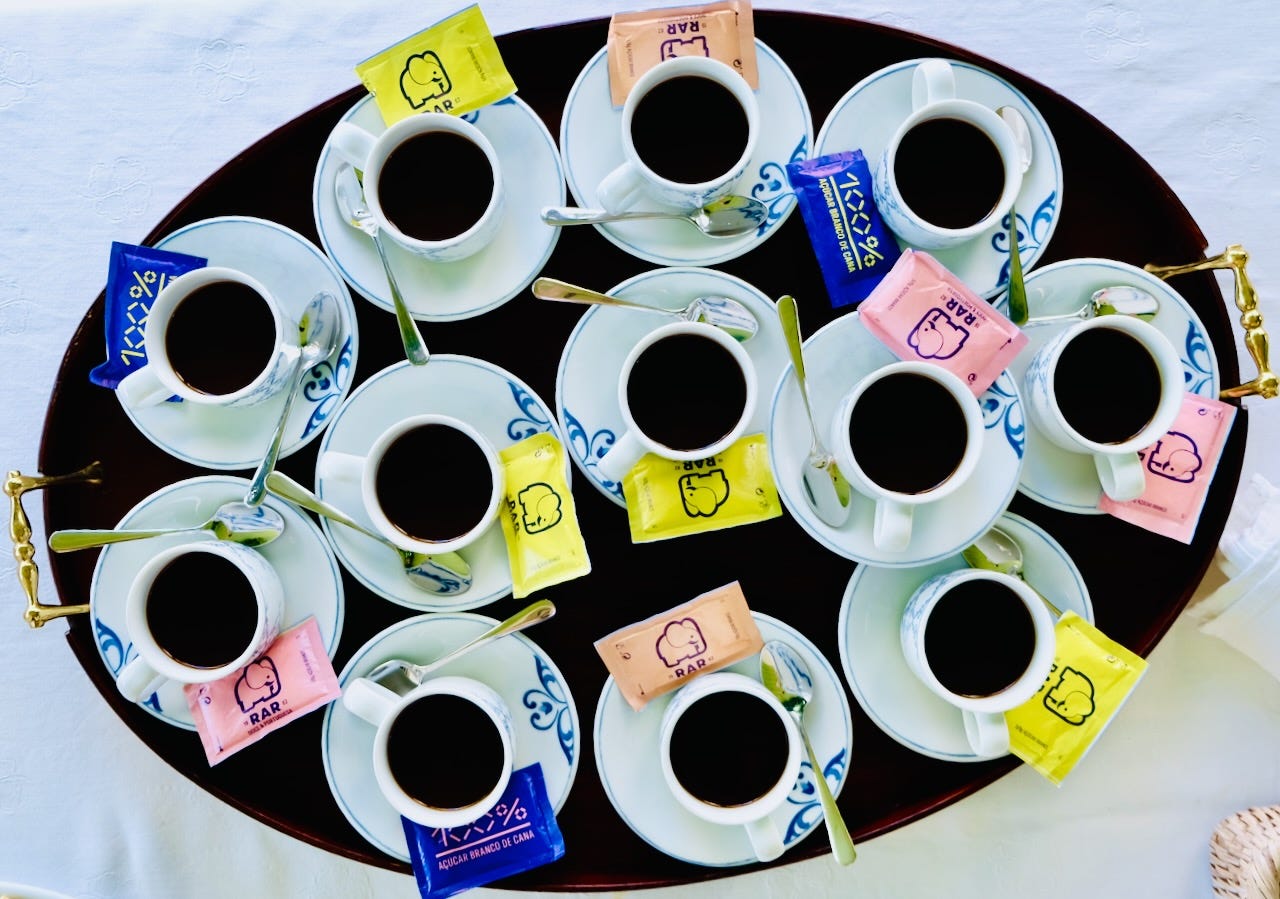
“Hotels have chefs. Hotels have sommeliers. Why don’t hotels have coffee directors?” Simon Worthington’s proposition—that hotels should pay more attention to their coffee programs—is so shatteringly obvious it should immediately send hoteliers scrambling. Coffee in the room, coffee in the lobby, coffee in the bar-café and restaurant, all of it should be considered holistically, thoughtfully integrated into the guest’s experience in time and place. Nespresso in the room is table stakes, he says, but what if the hotel were to partner with a local roaster to make bespoke pods? What if a guest could request of a coffee concierge a personalized beverage to be delivered to the room at a specific time each morning? What if the hotel had dedicated staff who were trained and resourced to deliver the highest quality coffee at any moment of day or night? “Coffee doesn’t need another machine. It needs a champion,” he writes. “Hotels already know the value of chefs, bartenders, and sommeliers because they understand that great hospitality rarely happens by accident. Coffee deserves the same treatment.” Next, let’s do the tea.
See you next week.
Coffees I have known ©2026 Meg Maker
Wines that create a vivid image in my mind are the holy grail for me. Doesn’t happen a lot, but when it does sparks fly.
Nice to read about a fellow Granite Stater and the struggles with crabgrass. I’ve been there.