


Wine is a contemporary cultural artifact, alive and vivid. Yet many of our ideas about what makes a wine good or bad are based on old beliefs—about prestige, purity, scarcity, measurability, traditionality.
As culture advances, many of these ideas have started looking stale. We owe it to wine (and to ourselves) to reappraise them periodically, embracing what still works while making adjustments that keep wine current.
Below are five examples I’m thinking about now.
Old idea: Assess wine using standardized methods
New idea: Enlarge the information space
Professional tasters attend to wine’s constituent parts: color, aroma, texture, savor, finish. These are subjective factors, but the assessment routine’s been so standardized as to make the exercise feel reasonably defensible. Tasters can also consider truly measurable factors like appellation, cépage, alcohol, acid, tannin, and price.
But wine’s complexities invite us to consider values that don’t inhere in the standard matrix, and may in fact stand completely apart. Often these arise from process and making, like how the vineyard workers are treated, whether the winegrowing is environmentally thoughtful, how the owners set corporate priorities. These factors aren’t always neatly discoverable, so sometimes we have to dig for answers and make a judgment call.
Consider a naturally made, delicious wine, but one that’s produced by an environmental monster. Now consider a nearly identical wine—same region, same grape, thoughtfully made, tasty, passes all the tests—made by an ethical producer that follows socially and environmentally regenerative principles. Which is the better wine? I think that’s easily answered.
Old idea: Honor established hierarchies
New idea: Add humanism
Hierarchy seems an immutable feature of wine: the Bordeaux Classification, quality pyramids, the one-hundred-point scale. Some hierarchies are metrical, based on zone, grape, must weight, finished sugar. (I’m looking at you, German Wine Law.) The definitions get updated over time, but usually by adjusting the target metric rather than rethinking the hierarchy as a whole.
Other hierarchies are looser, or are based on a mix of objective and subjective factors. A key metric for the Bordeaux Classification was meant to feel objective—the historical trading price—but this was actually a perceived value, viz., the price the market would pay. That the Classification has been vigorously contested for nearly two centuries proves the original assumptions were neither comprehensive nor ironclad.
But contestation is good, because it opens space for dialogue. It lets us add new factors or entire tiers that reflect current values—as in the example above, where we brought environmental and humanistic concerns into consideration.
More critical to the discussion of hierarchies is the fact that “best” is contextual. It doesn’t arise solely from exogenous factors like territory or making. A First Growth is absolutely an admirable wine, and it’s delicious in many contexts. But it’s not necessarily the wine I want tonight.
Old idea: Valorize Vitis vinifera
New idea: Celebrate Vitis diversity
Vitis vinifera means “the vine that makes the wine.” It literally means “wine grape.” The name was coined by Linnaeus in the mid-18th-century, but it captures an ancient idea about vinifera’s role in wine production.
Today vinifera has wandered the globe (albeit on North American rootstock). We love vinifera because it makes delicious wine. Or we could say we love vinifera because we’ve made it make delicious wine. Over centuries we’ve selected and crossed vinifera x vinifera to create new grapes with properties we value.
More recently we’ve also crossed vinifera with other Vitis species, often North American, to create interspecific hybrids that tolerate disease, fungus, temperature extremes, and more.[1] In the US, breeders focused first on cold hardiness, but newer projects considered factors like grape chemistry, resistance, vine architecture, and flavor.
The earliest hybrids failed to meet the expectations of a public used to the flavor and texture of vinifera, but progress has been made. In Europe, researchers created a class of fungal-resistant hybrids called PiWis[2] that have a recognizable flavor profiles thanks to a preponderance of vinifera genetics.
On the other hand, interspecific hybrids are never going to taste exactly like vinifera and we shouldn’t expect them to. Instead, they invite us pay attention to what they themselves taste and feel like, and, again, to expand our evaluative matrix.
Because planting hybrids can help new regions produce wine, keeping farmland agrarian and farming families intact. Hybrid grape wines can be made with less chemical input in field and cellar. Fewer inputs mean less expense, which could lower prices and expand access to more people. Hybrids can save resources in a resource-imperiled planet. I call that better wine.
Old idea: Revere historic forms
New idea: Renovate when needed
We venerate old vines. We personify them, call them crones or wise elders. Recently we’ve seen the launch of an old-vine registry, an old-vine conference, an old-vine research project, and other initiatives to preserve old vineyards worldwide. It’s strange, isn’t it, given our culture’s obsession with youth? Is our veneration about nostalgia and romanticism, or historicity and culture, or something else?
The definition of “old vine” is continually litigated. Is it a vineyard past its most productive period? One that’s 50 years old, or over 100? How does own-rootedness factor into the definition? The OIV, the international organization of vine and wine, has set the cutoff at 35 years, but hundreds of thousands of acres fall under that umbrella.
Old vines aren’t frozen in amber, they’re living organisms. Over decades they’ve made phenotypic adjustments to adapt to their context. They are stumpy, gnarled, and twisted; they are sprawling, rangy, and feral. Some have outlived their original keepers by decades. But many still produce, decorating themselves with ripe clusters at harvest, proving they’re not, in fact, crones. Old vines, like old forests, are carbon sinks. Plus their genetics hold valuable information about durability, adaptability, resilience, and deliciousness. We have ample reason to venerate and preserve them.
But old vines do fail, not only single plants but entire plots. This can bring opportunity, especially if the original vines were mismatched to site, or the soil health is failing, over-sprayed and under-fed. Replanting is a judgment call. But a fresh plantation may set up a site for the next hundred years.
Old idea: Follow the ritual
New idea: Follow the pleasure
Wine is bound up in ritual. The right glass, the right occasion, the right wine with fish. For millennia we’ve used wine in ceremonies honoring gods and kings, births and deaths, harvests, rites of passage. Wine’s been a sacral object for so long it has transmogrified, become itself the center of ritual attention.
Most of wine’s ceremonial routines are designed around enjoyment. A somm enacts an elaborate tableside choreography, but it’s supposed to help the diner relax into their anticipation. A wedding guest sabers the champagne not to alter the wine but to alter the color of the occasion. Wine professionals have their own rituals and routines; a seated tasting hall feels as ceremonial as a church. A blind tasting exercise literally looks cultish.
To the uninitiated the practices are mystifying, quasi-religious, the rules opaque, even actively hidden. Breaking them might have consequences; Maybe I should just have a beer. Wine’s elasticity, its somatic and emotional entry point, becomes stiff and brittle. The drinker is bridled by doubt. Am I doing this right? isn’t a happy question when you and your companion are in the active pursuit of sensual gratification.
So, bluntly: Screw the rules that don’t serve pleasure. Open the doors of the temple. Wine isn’t the point, we are.
An unexamined wine is not worth drinking.
[1] The results of these crossings are not genetically modified organisms, or GMOs. Traditional plant breeding uses only genetic material from parent vines, and the result is a plant with exclusively vine-native DNA. Genetic modification inserts foreign DNA into a plant’s gene sequence, creating an organism that has both its own and foreign genetic material.
[2] PiWi comes from the German Pilzwiderstandsfähige Traubensorte, meaning “fungal resistant grape variety.”
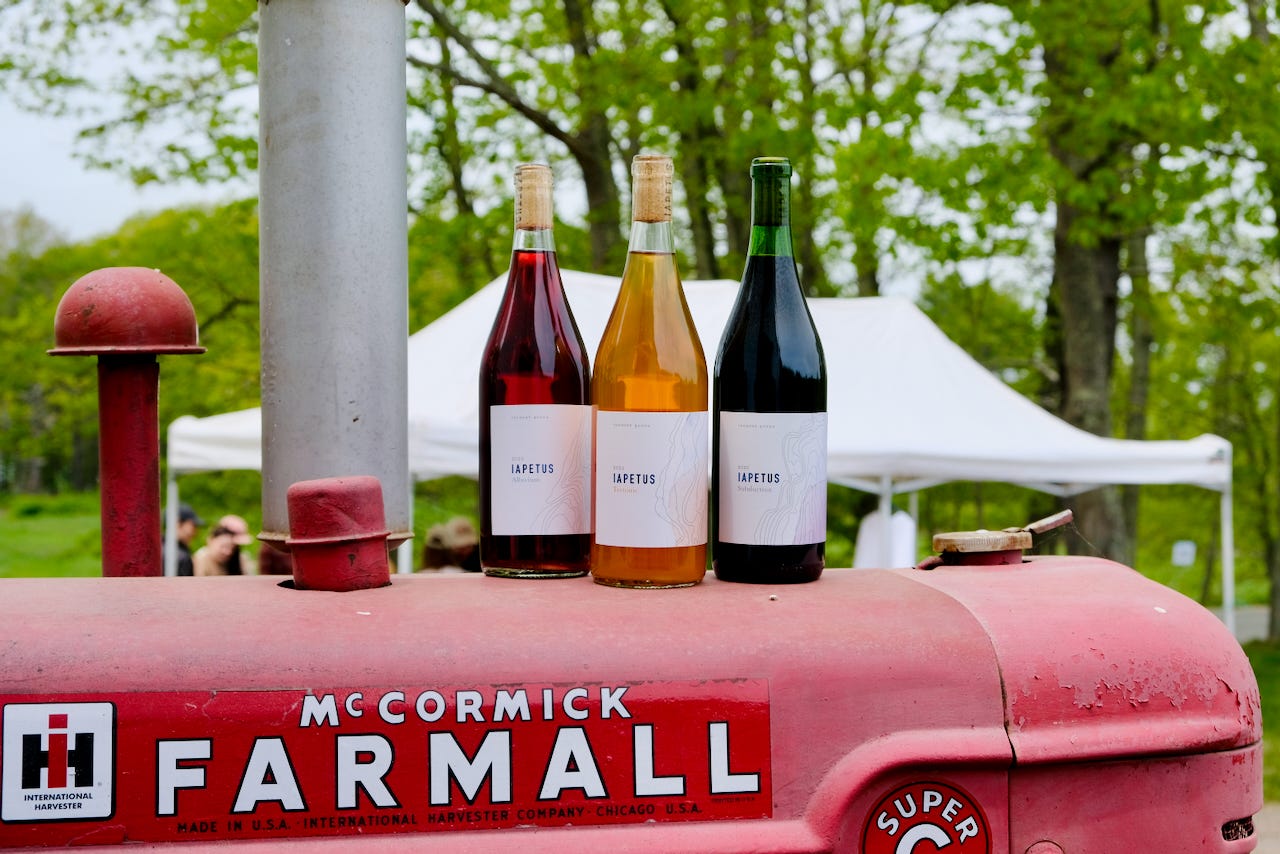
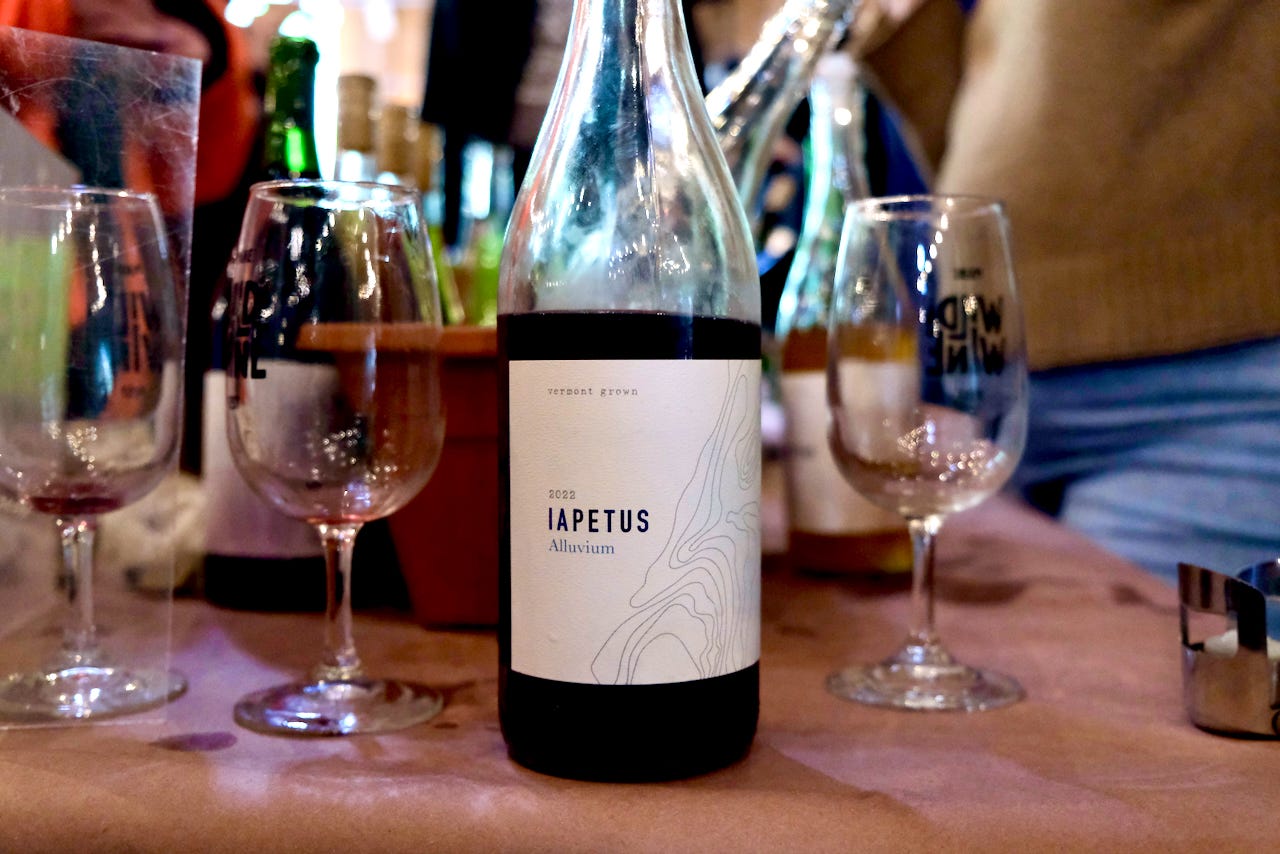
Photos ©2026 Meg Maker. Iapetus is a Vermont producer of natural wines made from hybrid grapes. Maine Wild Wine Fest is a natural wine tasting held annually in the spring in Freeport, Maine.
Enjoyed this so much! Serious topics but with such fun and insightful takes!!