

Just Say “La Domaine.”
I’d never tasted the wines of Domaine de la Romanée-Conti. I still haven’t.

April 2017. I was midway through a weeklong French wine media trip hosted by a U.S. wine importer. The tour started in Cognac and swept clockwise around l’hexagone française to Paris, Champagne, Burgundy, Beaujolais, the Southern Rhône, and Provence. On Day Four our group of five journalists and two company reps had sat for a tasting and lunch at Domaine Leflaive, in Puligny-Montrachet. Then we’d piled back into the van for our next appointment.
I was in the front seat thanks to a weak stomach further weakened by travel. At the wheel was our host, Alban de Brosses, the company’s French portfolio specialist. He is a compact man, muscular, impeccable in that casual French way. He speaks flawless, lightly accented English.
“Okay, everyone,” he announced. “A few things to know. First, don’t call it DRC. They don’t like that. Use the full name or just say La Domaine.”
Good to know. Domaine de la Romanée-Conti was a client of theirs, but they weren’t on our agenda. I figured de Brosses was merely advocating for his client’s, and his culture’s, patrimony.
“Bertrand de Villaine is the co-director with, of course, his uncle Aubert,” he added.
Duly noted.
“And you can spit, just be discreet.”
“Wait—what?”
He shrugged. “We’ll be there in fifteen minutes.”
I looked back at my bemused colleagues. “When did you guys know?”
“Yesterday!” they said, in chorus. “Where were you?”
Probably in les toilettes. De Brosses must have told the group during a rest stop. I pulled out my printed copy of the itinerary and noticed this small note at the bottom of the page, after the day’s lunch:
Depart for ‘surprise’ Winery in Burgundy
more details to be provided accordingly
Perhaps I’d read this when I’d first received the trip details. Perhaps it had been added later. I felt like a kid whose parents had just told her, Pack for Disney World, we’re leaving tonight. At least there was no time to get nervous. There was also no time for research. I’d never tasted their wines, which are some of the most respected, and most expensive, in all of Burgundy. In all the world.
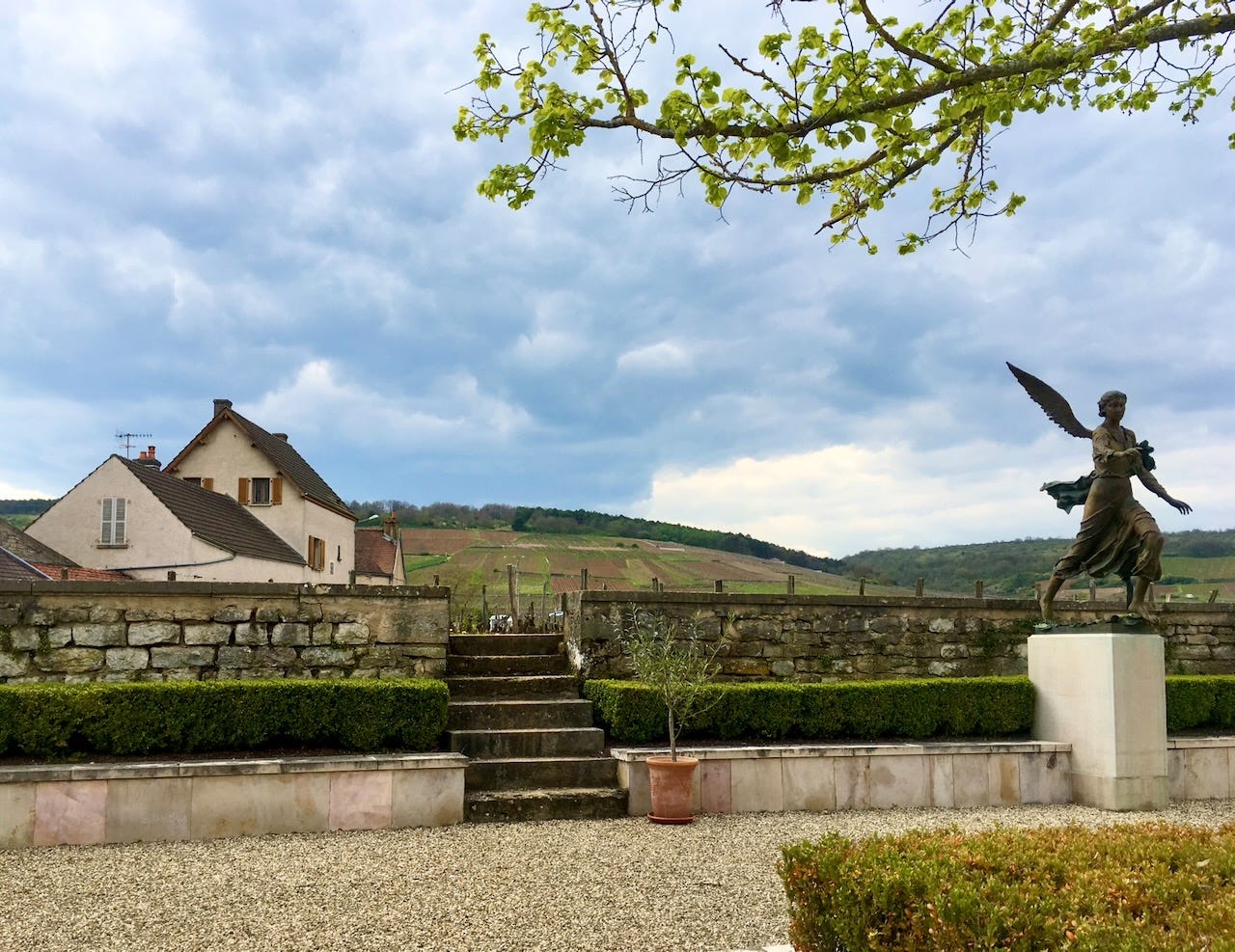
The van disgorged us onto a corner of Place de l’Eglise, in Vosne-Romanée, No. 1 Rue du Temps Perdu. The domaine lay across a courtyard behind iron gates. A child’s orange ball languished near the front door. An older man shuffled out carrying a 3-pack of wine. The gates swung open and our boots crunched cobble as de Brosses ushered us forward. A bronze angel guarded the square. Beyond lay the vineyards of Vosne-Romanée, fenced by a low wall with seven stone steps leading up to famous dirt.
Bertrand de Villaine emerged carrying a wine glass and thief. A stocky man, ruddy, friendly, he wore a brown zip fleece and black jeans. We shook hands all around. De Brosses kept us in formation as de Villaine led us into the chai, waving at the vinification area, a small room crowded with wooden vats. It’s not easy to produce wine in diminutive Vosne-Romanée, or really anywhere in Burgundy’s tiny communes and villages. “The big problem in the area is space,” de Villaine said. “Every time you want to build something, you have trouble with space.”
He led us downstairs into one of their aging rooms, a modest vaulted chamber with four rows of barrels in a single layer, perhaps sixty in all, separated by two narrow aisles. “You have to imagine we’re in a nursery. Each one is a baby,” said de Villaine. A baby in a special cradle. They buy barrels from François Frères, he said, specifying source material from the forests of Tronçais, Joupilles, and Bertrange. “Wood is one of the most important fixed assets we have. We are not buying barrels. We’re buying trees.”
We were beckoned into the aisle as de Villaine pulled the first sample, the 2016 Corton. Only eight months old, it was just beginning its malolactic conversion. The acids felt sharp and stinging, but the wine had a lively sense of violets and red fruit. De Villaine told us it was aging in a mix of new and one-year barrels, but the oak was barely legible.
We moved to the 2016 Échezeaux. Seventy percent of that vintage had been lost to frost in April. In a prior year, 2013, the yield was 13 hectoliters per hectare, but in 2016 they’d gotten just seven. This young wine was also going through malolactic, but it still showed gentle red fruit touched with stone and herbs. “Échezeaux is my baby,” said de Villaine, continuing the nursery theme. “It has the finesse to be a polite wine, accessible. A little complexity without being complicated.”
Next we tasted the 2016 Grand Échezeaux. Here was a bigger wine, more expansive and yet also spicier, with a peppery kick. The site always produces wine for long aging thanks to richer soil: more profound, literally and figuratively.
Domaine de la Romanée-Conti has long farmed organically. “It was the blood of the domaine for years,” our host told us. “First, the [lutte] raisonnée, then the biology (organics), then in 2007 we moved to biodynamics using horses, dynamized water, making our own compost.” They also follow biodynamic practices in the cellar, paying attention to flower and root days, to the phases of the moon and atmospheric pressure, especially for racking and bottling. But “It’s not an obsession,” said de Villaine. Although they use horses on six hectares, it’s “technically it’s not possible” to use them everywhere, even though they’re the best way to plow without compacting soil. Instead, they bought a few tractors weighing 800 kilos—the same as a horse.
The winemaking ethos is hands-off. “The work is ‘making wine,’ but we’re trying not to make wine. We’re trying not to act,” he continued. For example, “The first objective is not to rack the wine. Normally they don’t move. They don’t need to.” But they did have to do so in 2015, which he called an extreme outlier. They make the wine, in other words, classically, eliding some of the theosophical mumbo-jumbo of Steiner’s biodynamics and following the traditionalist approaches on which those had been loosely based, plus yielding to practical, not to mention economic, realities.
We moved next to the 2016 Romanée-Saint-Vivant. Here at last was a stinky wine that truly read as a work in progress. But it sorted itself out quickly in the glass, standing up in smart red fruit and spice. Then we tasted the 2015 Richebourg, which felt enormous, muscular, weighty. “The fame (reputation) is to be more firm, more savage, un peu dur,” de Villaine said of this wine. The next one could not have been more different: 2015 La Tâche. The wine floated, washing the senses in spring flowers, anise, violets, and cherries. The tannins were smooth like clay after rain.
De Villaine had called these wines babies, but they seemed more like teenagers, youths still earning voice and flesh, height, personality. They had charisma and charm, but weren’t yet fully who they would become.
We arrived at the end of the cellar. In a chapel-like niche lay a half-dozen barrels de Villaine called The Queen: 2016 Romanée-Conti. This wine always ages in this spot, the coolest in the cellar, which offers the slowest evolution. He stepped into the alcove to dip his thief into a barrel. While his back was turned, de Brosse intoned to us, sotto voce, “Don’t spit this wine. To show respect.”
De Villaine returned, beaming with a father’s affection. “I’m proud of the Echezeaux. I’m touched by the Saint-Vivant. I’m lost with the Romanée-Conti,” he said, dripping two fingers of wine into each glass. It seemed a recitation, not the first time he’d uttered this and likely not the last. I tasted spiced cherries steeped with rose petals, white pepper, anise. The texture was gentle, quiet, the tannins tea-like, but malolactic was popping. A skein of something darker threaded through the middle.
“The wine is something very simple,” de Villaine said, “It turns into a luxury product, but it’s not produced by being (to be) that.” Perhaps he meant only this wine, but I suspect he was referring to all of the wines in his petite crèche. Finally he collected our glasses and poured what remained back into the barrel. Apparently, the DNA of everyone who has ever tasted Romanée-Conti becomes part of the wine’s genetic signature.
The tasting wrapped. We said merci, goodbye, merci again. De Brosse suggested we walk west on Rue du Temps Perdu to see their vineyards and the tall stone cross that signifies their holdings. It was after 6 p.m. and the April sun was slanting gold into my eyes. The soil was newly plowed, red-orange in the evening light. I took a selfie, smiling with purple teeth.
—
I once had an elderly friend, a lifelong New Yorker. In the 1930s and ’40s he liked to visit the jazz clubs to hear the newest singers. One night he saw a striking young woman with a voice like liquid sunshine. After her set, he politely asked her to dance. As they swayed around the floor, he leaned forward and said, “You just keep singing, Ella. You’ll go far.”
Those barrel samples remind me of that young singer. Prodigiously talented but not yet famous. Supremely competent but not yet who she would become. Ella Fitzgerald, but not yet Ella Fitzgerald.
These wines were Burgundy, but not yet Burgundy. But also not sui generis. They were instead just the latest progeny of a centuries-old lineage that had started with the Romans, grown up with the monks, and matured with new generations of farmers and makers.
I still can’t claim to have tasted the wines of Domaine de la Romanée-Conti. But I can say I met them in their youth.
Image ©2026 Meg Maker. Travel and accommodations were provided by Wilson Daniels. Wine barrel samples were provided by Domaine de la Romanée-Conti. I’m grateful to Bertrand de Villaine for sharing his time and expertise.