


Welcome back to Notable, where I write about interesting wines from recent tasting. Lately I’ve enjoyed many wines without a pen or tablet at hand, poured with dinner as distractions from the world rather than attractions unto themselves.
But every few weeks my husband and I host a friend for a purposeful tasting. The friend provides wines that have slumbered for decades in his cold northern cellar, and I provide whatever samples I’ve been working through. It’s a study in contrasts, since the samples are invariably new releases still figuring out their new lives in bottle, while the aged wines, mostly French classics, have lived so long in bottle they’ve already had to redecorate twice.
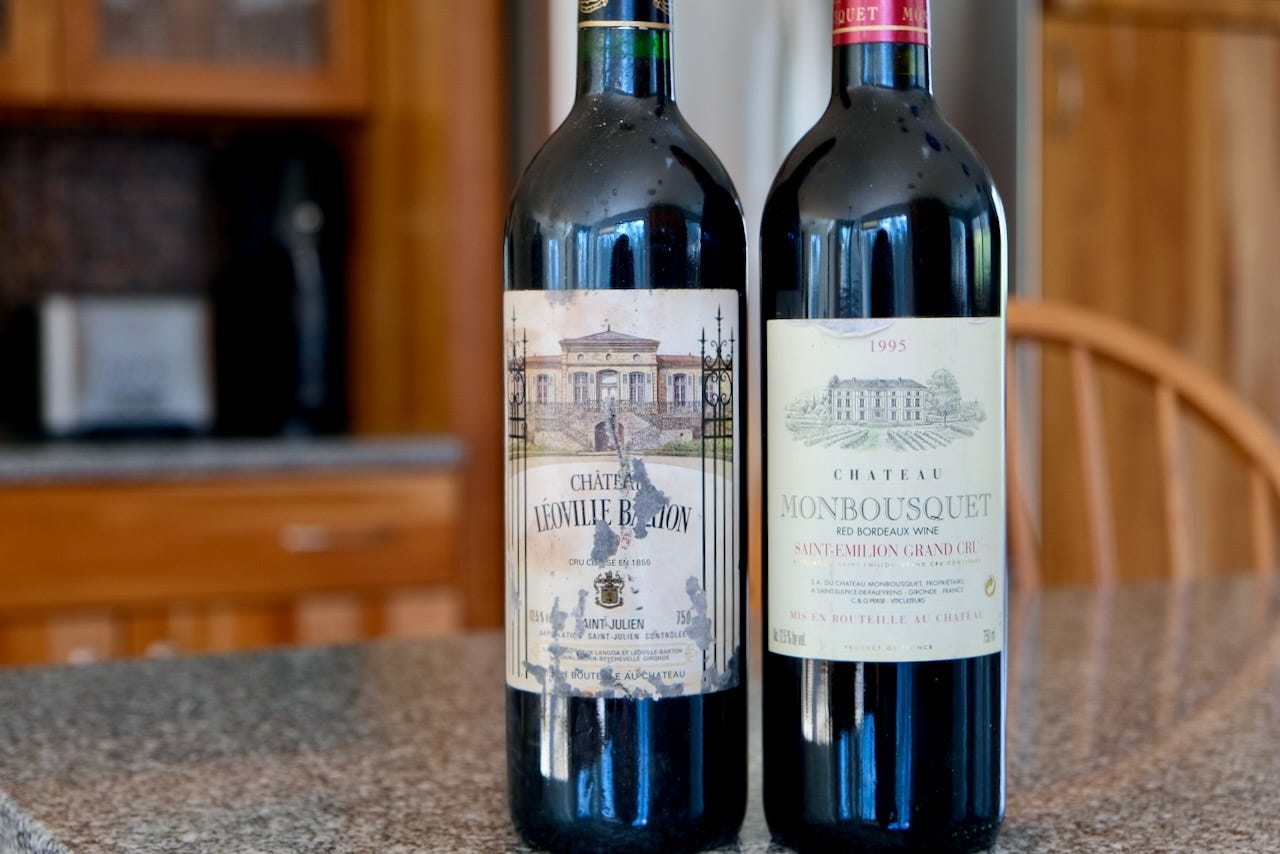
Recently he offered these two Bordeaux, from Left Bank and Right, both from the 1995 vintage: Château Léoville Barton Saint-Julien and Château Monbousquet Saint-Émilion Grand Cru.
One of them was wonderful, and the other was flawed, but so subtly it sent me on a chase to find out why and how, and especially whether the flaw had originated in making, aging, or a mix.
Let’s start with the better wine.
Château Monbousquet Saint-Émilion Grand Cru 1995
12.5% ABV | Vintage available for about $125; originally imported by Jeffrey M. Davies Selections
Monbousquet has been farmed continuously since 1682. In 1993 it was acquired by grocery magnate Gérard Perse, who undertook a major cellar overhaul, drained and restructured the vineyard, and even planted some white grapes, the first in Saint-Émilion. He also brought in Michel Rolland as consulting enologist.
In 1998, Robert M. Parker Jr. wrote that the wines had swiftly improved, shedding their reputation as “soft, innocuous, and commercially styled” and becoming “multi-dimensional, complete St.-Émilions that will age for two decades or more.” Parker liked this 1995 vintage, declaring it “full-bodied, super-extracted, multi-layered” (and multi-hyphenated).1
In 2006 the château earned, and has retained, the rank of Grand Cru Classé. Today they farm 32 hectares, 60 percent Merlot, 30 percent Cabernet Franc, and 10 percent Cabernet Sauvignon, with an average vine age of 42 years. The blend always reflects these vineyard proportions. They also grow minuscule portions of those white grapes (Sauvignon blanc, Sauvignon gris, Sémillon, and Muscadelle) from which they make a dry white wine.
In the glass, the 1995 Grand Cru was youthful looking, the aromas spiritous, offering a sweet scent of oak and spice, woodsy black and red cherry fruit, mint, and tea. Smooth, seamless, texturally refined, it had flavors of red fruits, licorice, juniper berry, and pine. It felt still vital and alive thirty years beyond harvest, like a preternaturally mature teenager, youthful body but wise eyes.
Château Léoville Barton Saint-Julien 1995
12.5% ABV | Vintage available for about $160; originally imported by W.J. Deustch & Sons Ltd.
Léoville Barton is a Deuxième Cru Classé estate. The wines are made at sister property Langoa Barton, as the original château building went out of ownership in 1826. Soils are characteristic gravel over clay, currently planted to 77 percent Cabernet Sauvignon, 20 percent Merlot, and 3 percent Cabernet Franc, with an average age of 40 years.
The wines have a reputation for stern tannic structure thanks to the relatively high proportion of Cabernet Sauvignon (for Saint-Julien). This gives them a long runway in bottle and lengthy maturity windows of even three decades. In 1998, Parker declared the 1995 bottling “somewhat closed and reticent… but still impressive,” with softer tannins than other recent vintages; overall “an outstanding textbook St.-Julien” with a maturity window of 2004–2025.
And here we are. The wine would have evolved slowly in that cold Vermont cellar, but should have found its footing by now. The color was reasonable, red and lightly stained with age, but aromatically the first hit was wet dog or wet wool. There were also some quiet scents of red fruit and anise and tea and wood; this was certainly a well-aged wine. The acidity felt forward but the tannins were softened, and while there was a hint of savory fruit flavors, the wine seemed to vanish mid-palate before its finishing acidity rushed back in at the sides of the tongue.
I let it linger in the glass a while but that wet wool character did not dissipate, standing between me and enjoyment of whatever else the wine had to offer. My fellow tasters weren’t as put off by these notes, and when my friend re-tasted it later, at home, he said the wet wool dissipated somewhat with air but the wine continued to feel hollow in the center. “Possibly bottle variation, very, very slight TCA, lightly cooked, who knows?” he ventured, noting that he has five more bottles in the cellar.
Meanwhile, I was chasing the cause of the flaw. I had assumed it to be an oxidative fault, but in research ran across a suggestion that wet wool notes in aged wine can also arise thanks to reduction. In this case, the theory went, the extremely cold cellaring conditions and the wine’s hard tannins both protected it from oxidative aging, creating disulfides, or volatile sulfur compounds.
Lacking any clarity, I reached out to my friend and colleague Keith Grainger, a winemaking consultant and educator and the author of the indispensable professional tome Wine Faults and Flaws: A Practical Guide.
Keith replied that he’s quite familiar with this wine and has tasted this particular vintage at least five times. Regrettably they’ve often missed the mark. “On one occasion the wine bottle was haloanisole tainted (corked) and the other bottles all showed weaknesses, particularly exuding hard tannins.”
As for my bottle, “The ‘wet wool’ you describe can be a symptom of oxidation, but also of volatile sulfur compounds (VSCs). I think it most unlikely that VSC’s are the issue with the wine you tasted. Oxidation is a possibility, and this can be amplified in cold storage conditions.
“Obviously I cannot say for sure without having tasted the wine, but I think it is most likely that the bottle was TCA or TBA tainted,2 albeit at a relatively low level. This sits perfectly with your descriptors of ‘little fruit and a vanishing mid-palate, as if it had a hole in the middle.’ The wine would not show the expected musty or damp sack aromas, but wet wool is not uncommon.
“There was, of course, a high percentage of tainted Bordeaux wines in the years up to 1997, due to chai contaminations and the problems of the cork industry. Bottles of Léoville and Langoa Barton had at least their fair share of such issues, as evidenced anecdotally in numerous blogs.”
I’m highly sensitive to haloanisoles and had not registered any of the characteristic musty-mold aromas, but now I know to look for other markers in a lightly corked, well aged wine. And kudos to my friend for suggesting slight TCA, the answer that most likely hit the mark.
Images ©2026 Meg Maker
Parker, Robert M. Jr. Bordeaux: A Comprehensive Guide to the Wines Produced from 1961 to 1997. New York: Simon & Schuster, 1998; p. 1098.
TCA is 2,4,6-Trichloroanisole and TBA is 2,4,6-Tribromoanisole, chemicals responsible for cork taint in wine.
As much as I love Leoville Barton, the number of corked bottles from the 1990s drives me crazy.