


In graduate school I took a course from a professor who held doctoral degrees in both philosophy and cognitive science. We read broadly about the philosophy of mind, computational theory, connectionism, and embodied cognition. This last theory asserts that our physical being and perceptual systems are essential for generating our higher thoughts. Mentation and sensation, in other words, are not separate processes; the mind makes the body perceive, and the body makes the mind think.
Our class also read about the Turing Test and Chinese Room problem, both of which say, essentially, that if a machine can convince you it’s thinking, then it’s thinking.
It feels like we’ve gotten there, doesn’t it? I pose a question to Gemini about my research, and it answers in complete and readable sentences with the information I need. Or it predicts it’s the information I need. It’s often incomplete, or downright erroneous. Formulating and then modulating queries are essential skills for the researcher. And I use other digital sources, including research indices and good old-fashioned Google, plus analog materials (books—remember them?). These other media are feeling increasingly clumsy and archaic, but they still manage to unearth otherwise undiscoverable nuggets.
I was an early adopter of search engine tech. After hand coding my first website, in 1992, I landed a job as an information architect and front-end designer at a tiny five-person startup putting stock-footage library catalogs online. The work involved ingesting millions of text-based, shot-level records aggregated by our clients, sources like ABC News, NBC, National Geographic, CNN, and The Image Bank, and feeding them into a vast textual database. We made this data searchable, for free, by film and television producers on the new magic lantern called the Internet. Soon we were also processing and indexing the footage itself and sending those results through the thread-thin straws of the early web.
The key to our success—and we were successful; the company was swiftly acquired by a larger entity—was our support for natural language querying. “Shark swimming in Cuban waters,” or “riot at Sing Sing Prison,” or “Nixon speeches.” Today such queries seem simplistic compared to the chatty badinage of Claude and ChatGPT. Back then it required us developers to parse synonyms, apply fuzzy logic, focus on weightings, and ignore stop words like the, and, at, and a. And we didn’t make users learn Boolean logic—this AND that NOT other—they could just type the query that made sense to them. If we’d done our job well, the search engine would figure it all out and spit back something useful. As always, data out was only as good as data in, but we could rely on the integrity of the source material from the footage archives, which had been cataloged and indexed by trained library scientists, viz., real humans with specialized knowledge and skills.
Fast forward to today. The quality of search chat is far more sophisticated, and the language seems so natural it readily lulls us into a belief the machine is thinking. But the source material is a mess, essentially everything that’s published to the Internet and even stuff that’s not, stolen from other sources. And it’s not indexed or curated or assigned weights by real humans. It’s too big. The scientists working on A.I. aren’t working on the corpus itself, as the library scientists had done to those footage archives. They’re training the machine to do that work, to parse the meaning inherent in the system.
It’s impressive, I admit. I’ve come to rely on it as a writer. Machine search, translation, and transcription have saved me limitless hours. Using this new tool feels like being handed a full meal instead of turning over rocks to forage for scraps.
But I’m mindful that I’m not only a writer. My expertise isn’t just “writing,” it’s writing about lived experience. To do that well, I have to tune into my own messy human wetware: tactile sensations, memories, the physiology of taste. I need to pass those signals through the rest of my nervous system, especially but not exclusively my brain, using judgment and creativity to formulate a novel idea. And then I have to put that idea into words using affective language another human might want to read. Writing about wine feels like a proof of the theory of embodied cognition: I can only know—hence write about—what my whole body can comprehend.
And, yes, if that writing then goes onto the internet, which most of it does these days, the machine will scrape it into its wide mechanical maw and store it as fat in its ever-expanding virtual corpus. But at least for now, if the writing is about taste, meaning both flavor and discernment, humans are the only ones who can do that thinking.
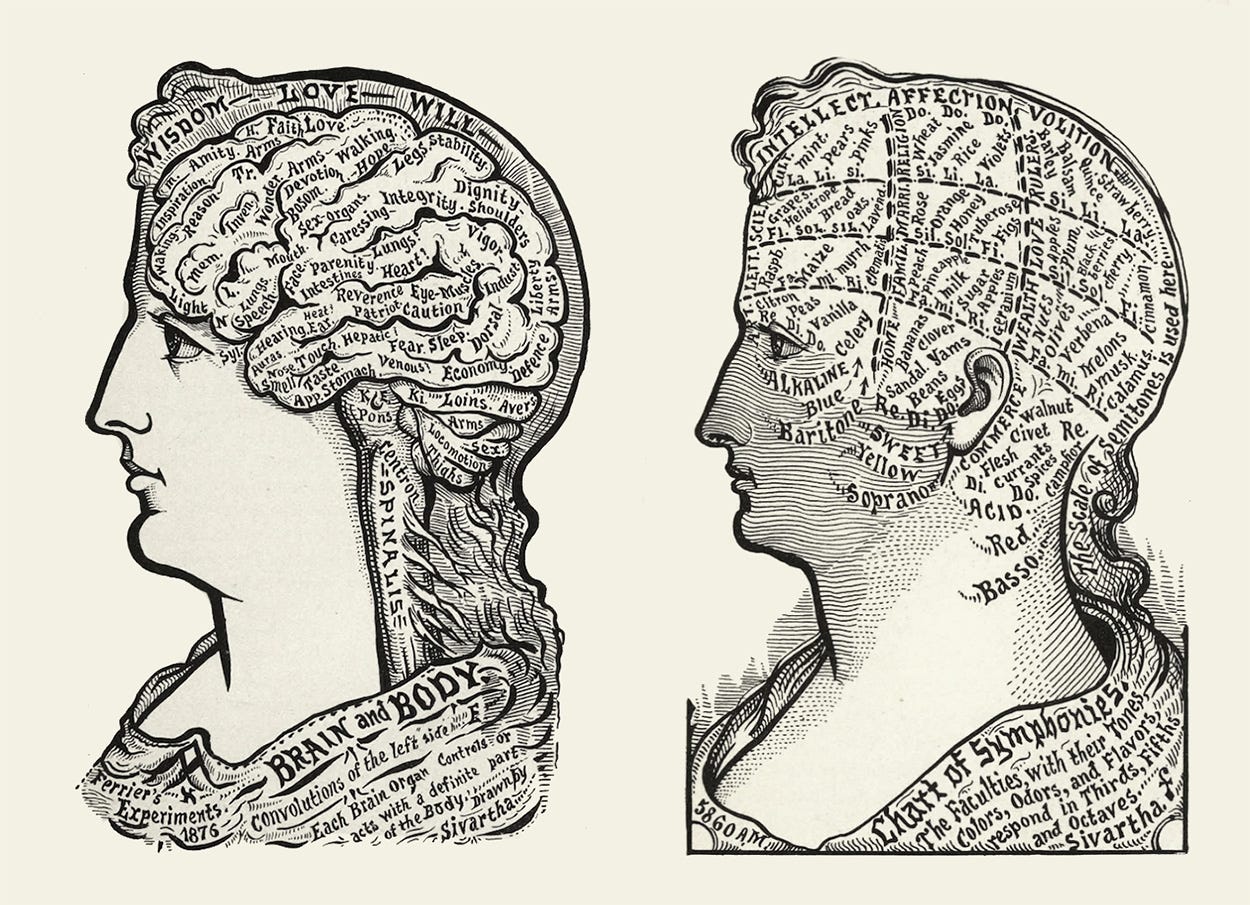
Images: “Convolutions” (left) and “Odors and Flavors,” from The Book of Life: The Spiritual and Physical Constitution of Man by Dr. Alesha Sivartha, 1898, courtesy of The Public Domain Review. An earlier version of this essay was published in The Circular.
I love this post, and your experiences are fascinating.
A few thoughts in no real order, and perhaps no connection to each other.
1. What I find interesting is how many times the Turing test's goalposts have shifted, and I think it's because human thinking and probably, at some level, consciousness isn't quite as simple as we thought.
2. When I first used Claude, I was blown away. I had to verbally (aloud!) remind myself that Claude was not, in fact, a god in a box. It was not omniscient, despite its "intelligence" and confidence. ... I'm not sure what was more surprising - Claude's ability, or my human desire that something would be omniscient - that there would be a god in a box that could tell me the secrets of the universe, what I should be when I grow up, how to make money, or which wine pair with what...
3. Sometimes when I have conversations with claude now, it will say, "I laughed out loud." And I thought, "no you didn't. You can't laugh. And you can't do it out loud." I find myself really irritated that it is trying to pass itself off as a human sometimes.
4. I have used AI plenty - to help me understand concepts that I don't understand, to find typos. However, I find myself using it less and less because I wonder if some of the "time-saving" processes that I'm saving time on were actually synergistic experiences - the very one that makes human thought so amazing, magical, and impossible for AI to actually approximate.